  1. Home
  2. Space
  3. News

Virgin Galactic completes second suborbital test flight from Spaceport America

Add as a preferred source on Google
Mission Recap: Virgin Galactic's SpaceShipTwo Unity completes second flight from Spaceport America.

Virgin Galactic has successfully performed a second test flight of its SpaceShipTwo Unity spacecraft from Spaceport America. The company aims to get ahead of the space tourism curve by offering suborbital flights which will take passengers to the edge of space, and this latest test flight brings it one step closer to making that a reality.

Recommended Videos

The company completed its first test flight from Spaceport America last month, practicing starting trips from the same location that will be used by paying passengers. The spaceport is located in Sierra County, New Mexico, and was created specifically for use by commercial entities, allowing the launch of spacecraft that take off either vertically or horizontally.

For this test flight, SpaceShipTwo Unity was piloted by Mark ‘Forger’ Stucky and Michael “Sooch” Masucci, both of whom have previously piloted the craft, and performed a glide flight. This is where the craft was taken into the air by a carrier aircraft, VMS Eve, and released at an altitude of 51,000 feet.

SpaceShipTwo Unity then glided through the atmosphere, reaching a speed of Mach 0.85, and performed a series of maneuvers that allowed the collection of performance data before the Unity landed on a runway back at Spaceport America.
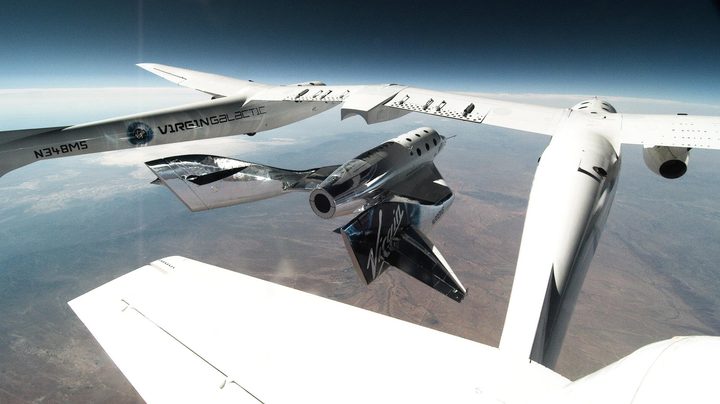
SpaceShipTwo Unity Released From VMS Eve for Second Glide Flight in New Mexico
SpaceShipTwo Unity Released From VMS Eve for Second Glide Flight in New Mexico Virgin Galactic

George Whitesides, CEO of Virgin Galactic and The Spaceship Company said: “I am thrilled with the team’s hard work to complete today’s test flight successfully. It was an important test that, pending data review, means we can now start preparing the vehicles for powered flight. Our focus for this year remains unchanged on ensuring the vehicles and our operations are prepared for long-term, regular commercial spaceflight service.”

The company has said its next steps are to analyze the data from this test flight and then perform a powered test flight of the craft.
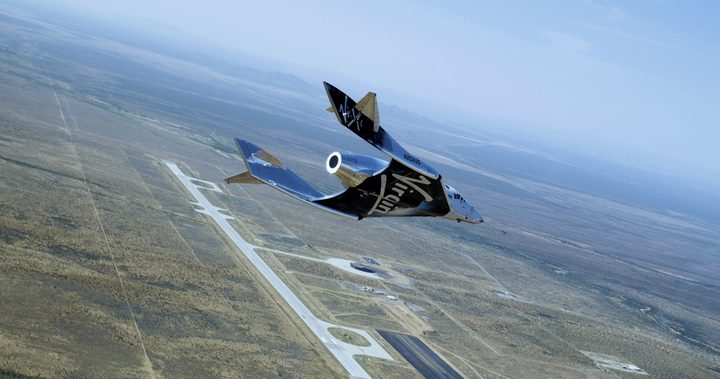
SpaceShipTwo Unity Second Glide Flight over Spaceport America
SpaceShipTwo Unity Second Glide Flight over Spaceport America Virgin Galactic

Virgin Galactic has an interest in going beyond suborbital flights in the future as well. Last week, the company announced it is entering a partnership with NASA to fly space tourists to the International Space Station in the future.

These trips will require the use of a different spacecraft than the SpaceShipTwo, which is not capable of orbital flight, but the company has not yet announced its plans for which vehicle it will use to carry passengers into orbit.

Georgina Torbet
Georgina has been the space writer at Digital Trends space writer for six years, covering human space exploration, planetary…
Scientists have found a hidden galaxy inside the Milky Way, and they’re calling it Loki
A lost dwarf galaxy may be hiding inside the Milky Way.
milky-way-hidden-galaxy-loki

Our home galaxy has a secret buried inside. A new study published in the Monthly Notices of the Royal Astronomical Society suggests that the Milky Way swallowed an ancient dwarf galaxy billions of years ago, and its stellar remains are still embedded within ours.

Researchers have named this lost galaxy Loki, after the Norse trickster god, and the name is quite fitting because it remained hidden in plain sight for a very long time.

Read more
NASA aims September launch for Roman space telescope and it’s going to be a huge shift
An earlier target for Roman means one of NASA’s most ambitious observatories is getting close, with the potential to open a huge new era in space discovery
Machine, Wheel, Astronomy

NASA is now aiming to launch the Nancy Grace Roman Space Telescope as soon as early September 2026, a faster timeline than its earlier commitment to fly no later than May 2027. That alone makes this one of the agency’s most important missions to watch over the next few months.

The reason is simple, Roman is built to scan vast parts of the sky with sharp infrared vision.

Read more
Blue Origin successfully re-uses a New Glenn rocket for the first time ever
Blue Origin achieves first New Glenn reflight despite payload setback
Blue Origin

Blue Origin has achieved a major milestone in its spaceflight ambitions by successfully reusing a booster from its heavy-lift New Glenn rocket for the first time. The historic launch, conducted on April 19, marks a significant step forward for Jeff Bezos’ space company as it seeks to compete with rivals like SpaceX in the rapidly evolving commercial launch market.

A Milestone With A Mixed Outcome

Read more