  1. Home
  2. Space
  3. News

Astronomers share early images from James Webb’s galaxy survey

Add as a preferred source on Google

One of the major aims of the James Webb Space Telescope is to observe some of the earliest galaxies in the universe, and to do that it needs to be able to see extremely distant objects. But looking at a particular very old galaxy in detail is only half of the problem. To truly understand the earliest stages of the universe, astronomers also need to see how these very old galaxies are distributed so they can understand the large-scale structure of the universe.

That’s the aim of the COSMOS-Web program, which is using James Webb to survey a wide area of the sky and look for these rare, ancient galaxies. It aims to study up to 1 million galaxies during over 255 hours of observing time, using both Webb’s near-infrared camera (NIRCam) and its mid-infrared instrument (MIRI) camera. While there is still plenty of observing left to do, the researchers in the COSMOS-Web program recently shared some of their first results.
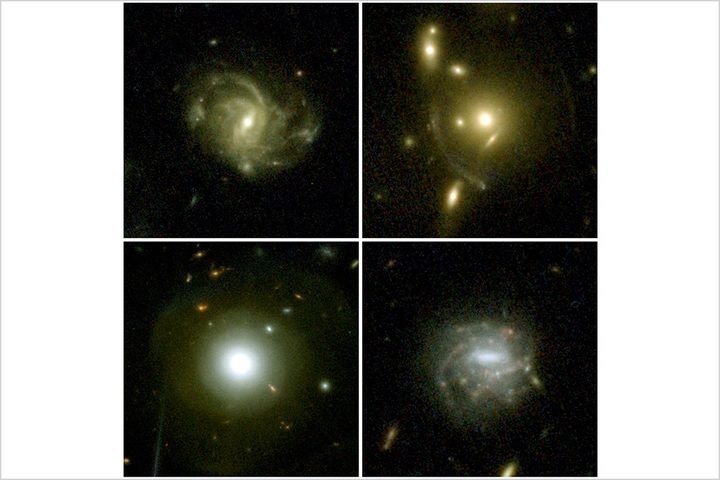
Images of four example galaxies selected from the first epoch of COSMOS-Web NIRCam observations, highlighting the range of structures that can be seen. In the upper left is a barred spiral galaxy; in the upper right is an example of a gravitational lens, where the mass of the central galaxy is causing the light from a distant galaxy to be stretched into arcs; on the lower left is nearby galaxy displaying shells of material, suggesting it merged with another galaxy in its past; on the lower right is a barred spiral galaxy with several clumps of active star formation.
These images of four example galaxies selected from the first epoch of COSMOS-Web NIRCam observations highlight the range of structures that can be seen. In the upper-left is a barred spiral galaxy; in the upper-right is an example of a gravitational lens, where the mass of the central galaxy is causing the light from a distant galaxy to be stretched into arcs; on the lower-left is sa nearby galaxy displaying shells of material, suggesting it merged with another galaxy in its past; on the lower-right is a barred spiral galaxy with several clumps of active star formation. COSMOS-Web/Kartaltepe, Casey, Franco, Larson, et al./RIT/UT Austin/IAP/CANDIDE

“It’s incredibly exciting to get the first data from the telescope for COSMOS-Web,” said principal investigator Jeyhan Kartaltepe of the Rochester Institute of Technology, in a statement. “Everything worked beautifully, and the data are even better than we expected. We’ve been working really hard to produce science-quality images to use for our analysis, and this is just a drop in the bucket of what’s to come.”

Recommended Videos

The first images include four galaxies, chosen because they represent the different types of galaxy that the survey will find. There is a barred spiral galaxy, like our Milky Way, and a similar galaxy undergoing vigorous star formation. There is also a galaxy that seems to have recently merged, and one galaxy whose light is bent due to gravitational lensing.
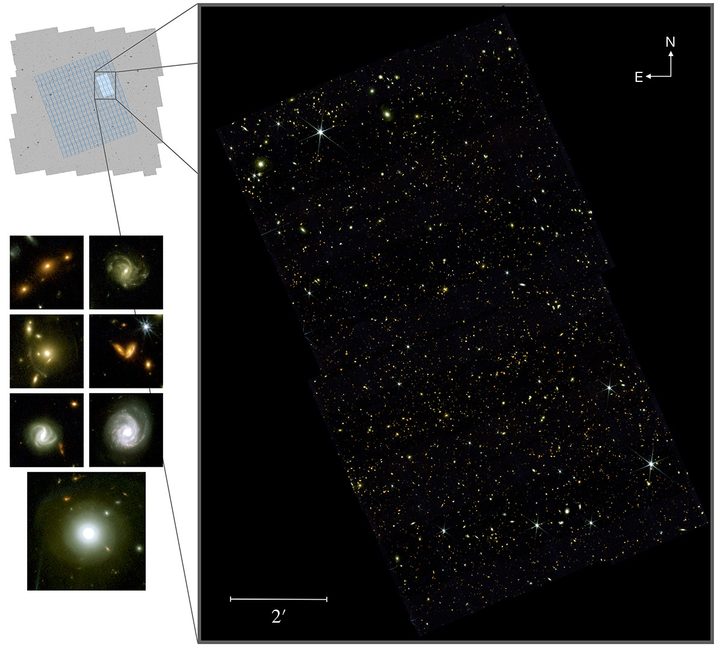
The first epoch of COSMOS-Web NIRCam observations obtained on Jan. 5-6, 2023, including the F115W, F150W, F277W, and F444W filters as a color composite. These data cover six visits or pointings out of a total of 152 visits. The total area covered by NIRCam here is ∼77arcmin^2. The relative position of this mosaic in the survey is shown at upper left. At lower left are several zoomed-in 10′′ × 10′′ cutouts and one 16′′ × 16′′ cutout showing specific galaxies selected from these first data.
The first epoch of COSMOS-Web NIRCam observations obtained on Jan. 5-6, 2023, including the F115W, F150W, F277W, and F444W filters as a color composite.  COSMOS-Web/Kartaltepe, Casey, Franco, Larson, et al./RIT/UT Austin/IAP/CANDIDE

These are just a tiny slice of the galaxies identified by the survey so far. The image above shows the observations taken between January 5 and 6 this year, giving an indication of just how big and detailed the eventual full survey will be. This mosaic was made up of six pointings by the telescope, out of a total of 77 to be made in April and May this year, with a further 69 coming in December 2023 and January 2024.

“This first snapshot of COSMOS-Web contains about 25,000 galaxies — an astonishing number larger than even what sits in the Hubble Ultra Deep Field,” said principal investigator Caitlin Casey of the University of Texas at Austin. “It’s one of the largest JWST images taken so far. And yet it’s just 4% of the data we will get for the full survey. When it is finished, this deep field will be astoundingly large and overwhelmingly beautiful.”

Georgina Torbet
Georgina has been the space writer at Digital Trends space writer for six years, covering human space exploration, planetary…
Scientists have found a hidden galaxy inside the Milky Way, and they’re calling it Loki
A lost dwarf galaxy may be hiding inside the Milky Way.
milky-way-hidden-galaxy-loki

Our home galaxy has a secret buried inside. A new study published in the Monthly Notices of the Royal Astronomical Society suggests that the Milky Way swallowed an ancient dwarf galaxy billions of years ago, and its stellar remains are still embedded within ours.

Researchers have named this lost galaxy Loki, after the Norse trickster god, and the name is quite fitting because it remained hidden in plain sight for a very long time.

Read more
NASA aims September launch for Roman space telescope and it’s going to be a huge shift
An earlier target for Roman means one of NASA’s most ambitious observatories is getting close, with the potential to open a huge new era in space discovery
Machine, Wheel, Astronomy

NASA is now aiming to launch the Nancy Grace Roman Space Telescope as soon as early September 2026, a faster timeline than its earlier commitment to fly no later than May 2027. That alone makes this one of the agency’s most important missions to watch over the next few months.

The reason is simple, Roman is built to scan vast parts of the sky with sharp infrared vision.

Read more
Blue Origin successfully re-uses a New Glenn rocket for the first time ever
Blue Origin achieves first New Glenn reflight despite payload setback
Blue Origin

Blue Origin has achieved a major milestone in its spaceflight ambitions by successfully reusing a booster from its heavy-lift New Glenn rocket for the first time. The historic launch, conducted on April 19, marks a significant step forward for Jeff Bezos’ space company as it seeks to compete with rivals like SpaceX in the rapidly evolving commercial launch market.

A Milestone With A Mixed Outcome

Read more