  1. Home
  2. Space
  3. News

James Webb captures vast structure created by newborn stars

Add as a preferred source on Google

Newborn stars are often active and glow brightly, but on some rare occasions, they can create something truly epic: a vast and bright two-lobed structure called a Herbig-Haro object.

These are formed when a new star gives off narrow jets of ionized gas, which shoot off in opposite directions and collide with nearby dust and gas. As the jets hit the material at speeds of hundreds of miles per second, they sculpt vast nebula-like clouds which can be hundreds of light-years across.
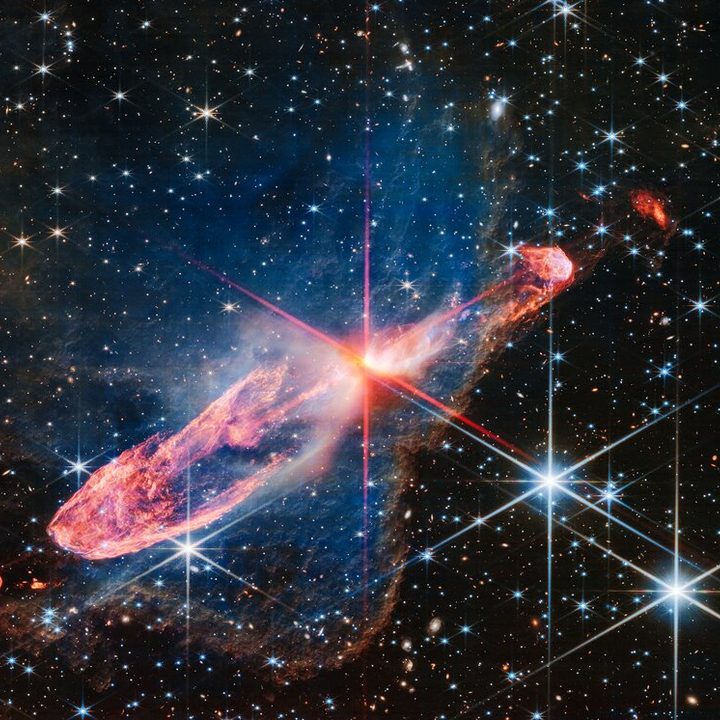
A high-resolution image of a tightly bound pair of actively forming stars, known as Herbig-Haro 46/47, in near-infrared light.
The NASA/ESA/CSA James Webb Space Telescope has captured a high-resolution image of a tightly bound pair of actively forming stars, known as Herbig-Haro 46/47, in near-infrared light. Look for them at the center of the red diffraction spikes. The stars are buried deeply, appearing as an orange-white splotch. They are surrounded by a disc of gas and dust that continues to add to their mass. J. DePasquale (STScI) / NASA, ESA, CSA

This particular example of the phenomenon is called Herbig-Haro 46/47 and was recently captured by the James Webb Space Telescope. In fact, there are a pair of stars at the heart of this object, which is located around 1,470 light-years away from Earth in the constellation Vela, and which stretches for over 3 light-years. The stars are located right in the center of the object, in the orange region around which the central diffraction spikes appear. These diffraction spikes are caused by the way light bends around Webb’s hexagonal primary mirror.

Recommended Videos

As Webb looks in the infrared part of the spectrum, it gets a different view of the object from other telescopes such as Hubble which look primarily in the optical wavelength (the same wavelengths seen by the human eye). In the infrared image, you can see the orange lobes spreading out from the central stars — this is material from older ejections, as the stars have been sending out jets for thousands of years. The newer ejections from the stars are visible in threads of blue.

All of this occurs over a background of dusty blue nebula. This nebula affects the jets as well, as Webb scientists explain: “This nebula is significant — its presence influences the shapes of the jets shot out by the central stars. As ejected material rams into the nebula on the lower left, there is more opportunity for the jets to interact with molecules within the nebula, causing them both to light up.”

Georgina Torbet
Georgina has been the space writer at Digital Trends space writer for six years, covering human space exploration, planetary…
Scientists have found a hidden galaxy inside the Milky Way, and they’re calling it Loki
A lost dwarf galaxy may be hiding inside the Milky Way.
milky-way-hidden-galaxy-loki

Our home galaxy has a secret buried inside. A new study published in the Monthly Notices of the Royal Astronomical Society suggests that the Milky Way swallowed an ancient dwarf galaxy billions of years ago, and its stellar remains are still embedded within ours.

Researchers have named this lost galaxy Loki, after the Norse trickster god, and the name is quite fitting because it remained hidden in plain sight for a very long time.

Read more
NASA aims September launch for Roman space telescope and it’s going to be a huge shift
An earlier target for Roman means one of NASA’s most ambitious observatories is getting close, with the potential to open a huge new era in space discovery
Machine, Wheel, Astronomy

NASA is now aiming to launch the Nancy Grace Roman Space Telescope as soon as early September 2026, a faster timeline than its earlier commitment to fly no later than May 2027. That alone makes this one of the agency’s most important missions to watch over the next few months.

The reason is simple, Roman is built to scan vast parts of the sky with sharp infrared vision.

Read more
Blue Origin successfully re-uses a New Glenn rocket for the first time ever
Blue Origin achieves first New Glenn reflight despite payload setback
Blue Origin

Blue Origin has achieved a major milestone in its spaceflight ambitions by successfully reusing a booster from its heavy-lift New Glenn rocket for the first time. The historic launch, conducted on April 19, marks a significant step forward for Jeff Bezos’ space company as it seeks to compete with rivals like SpaceX in the rapidly evolving commercial launch market.

A Milestone With A Mixed Outcome

Read more