  1. Home
  2. Space
  3. News

Gorgeous Webb image of Serpens Nebula shows a strange alignment

Add as a preferred source on Google

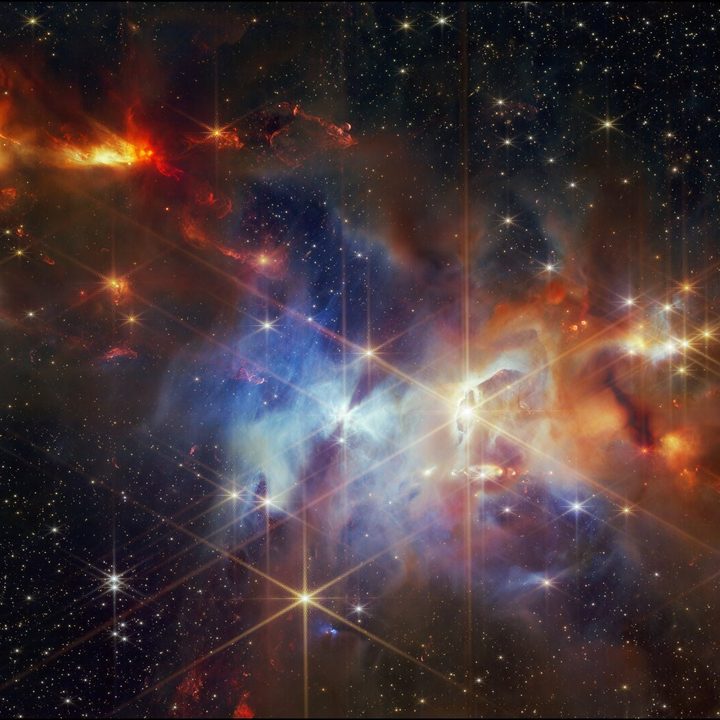
This image shows the centre of the Serpens Nebula as seen by the NASA/ESA/CSA James Webb Space Telescope’s Near-InfraRed Camera (NIRCam).
The Serpens Nebula, located 1,300 light-years from Earth, is home to a particularly dense cluster of newly forming stars (about 100,000 years old), some of which will eventually grow to the mass of our Sun. Webb’s image of this nebula revealed a grouping of aligned protostellar outflows (seen in the top left). These jets are identified by bright clumpy streaks that appear red, which are shock waves caused when the jet hits the surrounding gas and dust. NASA, ESA, CSA, STScI, K. Pontoppidan (NASA’s Jet Propulsion Laboratory), J. Green (Space Telescope Science Institute)

This stunning new image from the James Webb Space Telescope shows the famous Serpens Nebula, a dense star-forming region where new stars are being born amid clouds of dust and gas. Unlike some other nebulae, which are illuminated by radiation from stars that causes them to glow, this is a type called a reflection nebula, so it only shines due to the light that reflects from other sources.

Recommended Videos

As well as being visually striking, this image is also helping astronomers to learn about a special phenomenon related to newborn stars. When stars are first forming, they start as objects called protostars, and these protostars can give off extremely energetic jets of gas, which comes streaming off their north and south poles.

When this gas streaming off the protostar collides with nearby dust and gas, it creates shockwaves, which can be seen in the top left of the image. The red streaks of molecular hydrogen indicate these outflows, and one immediately noticeable thing about them is that they are all slanted at the same angle. This is the first time this phenomenon of aligned jets has been observed.

Normally, you would expect that a bunch of protostars would have outflows going in all different directions. So the fact these are all aligned suggests that there is something special going on in this region, which is affecting these young stars.

“Astronomers say there are a few forces that potentially can shift the direction of the outflows during this period of a young star’s life,” Webb scientists explain. “One way is when binary stars spin around each other and wobble in orientation, twisting the direction of the outflows over time.”

To learn more about the region, Webb scientists plan to use Webb’s NIRSpec instrument to understand what the cloud is made of, in addition to this data from Webb’s NIRCam instrument that was used to capture this image.

Georgina Torbet
Georgina has been the space writer at Digital Trends space writer for six years, covering human space exploration, planetary…
Scientists have found a hidden galaxy inside the Milky Way, and they’re calling it Loki
A lost dwarf galaxy may be hiding inside the Milky Way.
milky-way-hidden-galaxy-loki

Our home galaxy has a secret buried inside. A new study published in the Monthly Notices of the Royal Astronomical Society suggests that the Milky Way swallowed an ancient dwarf galaxy billions of years ago, and its stellar remains are still embedded within ours.

Researchers have named this lost galaxy Loki, after the Norse trickster god, and the name is quite fitting because it remained hidden in plain sight for a very long time.

Read more
NASA aims September launch for Roman space telescope and it’s going to be a huge shift
An earlier target for Roman means one of NASA’s most ambitious observatories is getting close, with the potential to open a huge new era in space discovery
Machine, Wheel, Astronomy

NASA is now aiming to launch the Nancy Grace Roman Space Telescope as soon as early September 2026, a faster timeline than its earlier commitment to fly no later than May 2027. That alone makes this one of the agency’s most important missions to watch over the next few months.

The reason is simple, Roman is built to scan vast parts of the sky with sharp infrared vision.

Read more
Blue Origin successfully re-uses a New Glenn rocket for the first time ever
Blue Origin achieves first New Glenn reflight despite payload setback
Blue Origin

Blue Origin has achieved a major milestone in its spaceflight ambitions by successfully reusing a booster from its heavy-lift New Glenn rocket for the first time. The historic launch, conducted on April 19, marks a significant step forward for Jeff Bezos’ space company as it seeks to compete with rivals like SpaceX in the rapidly evolving commercial launch market.

A Milestone With A Mixed Outcome

Read more