  1. Home
  2. Wearables
  3. Mobile
  4. News

Your Fitbit app is getting a big AI upgrade later this year

Add as a preferred source on Google
AI in Fitbit app.
Google

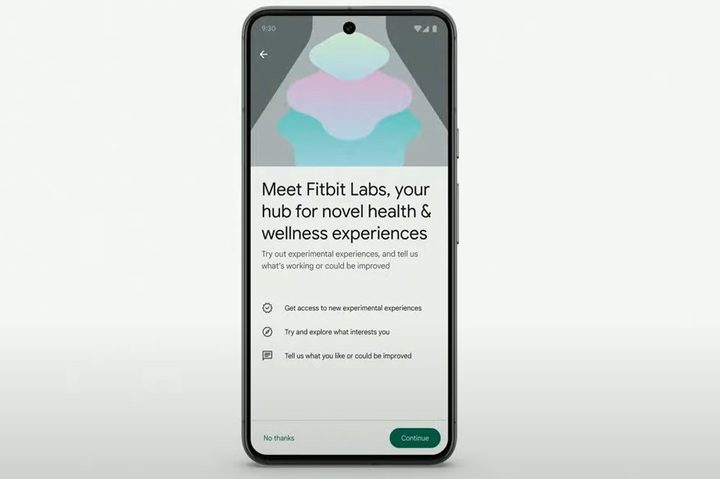
Google says it is bringing what it calls a “Personal AI” across its product portfolio, thanks to generative AI advancements and the development of models specifically for health care. Fitbit is a part of that vision and will rely on the experimental Fitbit Labs, where users will be able to access features later this year as part of a trial phase.

At Google’s recent The Check Up event, the company said it wants users to understand better the wellness data collected by the sensors on their bodies, both smartwatches and smartphones. An AI tool in the Fitbit app will assess that data and present it in an easy-to-understand format, like charts.

Recommended Videos

Of course, the AI will also offer actionable insights to users based on their workout and lifestyle routines. But there’s a chatbot twist here. Google has built an AI assistant that users can talk to about their health data and gain more detailed insights.

For example, users can ask it questions like, “Is there a linked pattern between my sleep habits and daily activity metrics?” In such scenarios, the AI will review the sleep and activity log and give users the required insights, such as telling users how they sleep better on a day when they are more active based on their daily active minutes data.

Personalized AI recommendations in Google Fibit app.
Google

Down the road, it will be able to establish links between more biomarkers such as heart rate activity, exercise intensity, heart rate variation, and more. The experience will be available for “a limited number of Android users” who have signed up for Fitbit Labs testing. Google is also developing a Personal Health Large Language Model to bring such health-focused AI features to life.

Google says it will be a fine-tuned version of the company’s Gemini model, which is already running natively on devices like Google Pixel 8 Pro and Samsung Galaxy S24. The ultimate goal is to create an “on-demand personal coach” that can not only offer valuable insights but also guidance that can help users make changes and improvements wherever necessary.

The Check Up with Google Health

In the near future, these AI-driven health experiences will be delivered via Pixel phones, Fitbit and Pixel Watch wearables, Pixel smartphones, and Pixel earbuds.

Of course, there’s a standard disclaimer here. “It is not meant to diagnose, treat, mitigate, cure, or prevent any disease, injury, or condition,” says Florence Tang, Google’s Director of Product. Instead, it is simply meant to help users reach their fitness goals with more information and guidance than ever before, thanks to AI.

You can read more about Google’s Personal Health Large Language Model and the AI-tethered health innovations while The Check Up event is embedded above.

Nadeem Sarwar
Nadeem is the Managing Editor at Digital Trends.
Google and Xreal’s Project Aura smart glasses will ship later this year
Xreal Project Aura smart glasses come with built-in display units and run Android apps.
Front view of Xreal Project Aura smart glasses.

Google is working on a whole bunch of smart glasses. The first one running on the Android XR platform developed by Samsung is expected to arrive close to July. The slate, it seems, will get crowded pretty soon. Earlier today at the I/O 2026 Developers Conference, Google also showed off a new class of audio glasses that have been designed in partnership with Warby Parker and Gentle Monster.

But the most interesting of the bunch is the Xreal Project Aura smart glasses, which support full hand gesture support as well as mixed reality view for Android apps available through the Play Store. These smart glasses were first showcased in December 2025, but Xreal confirmed earlier today that the Project Aura smart glasses will hit the shelves in 2026. 

Read more
Wear OS 7 promises 10% better battery life and adds Gemini Intelligence… for select 2026 models
Limiting Gemini Intelligence to select future watches while existing Pixel Watch owners wait is exactly the kind of fine print that turns a promising announcement into a frustrating one.
Sphere, Person, Gauge

Google announced Wear OS 7 at I/O 2026, and for the Pixel Watch owners who have spent years watching Apple pile features onto watchOS, this one might feel like redemption. 

The latest Wear OS update promises up to 10% better battery life compared to Wear OS 6, which is meaningful for a device where every hour of battery life counts. And, more importantly, Gemini Intelligence is coming to Pixel Watches later this year (with an asterisk the size of a watch face).

Read more
Google shows off Android audio glasses designed by Gentle Monster and Warby Parker
Designed in collaboration with Warby Parker and Gentle Monster, the smart glasses will arrive later this year.
Gemini smart glasses.

At the I/O 2026 Developer Conference, Google gave us our first look at the upcoming Gemini-powered Intelligent Eyewear. Running atop the Android XR stack, these glasses have been developed in collaboration with Samsung and Qualcomm, while the design DNA has been developed by Gentle Monster and Warby Parker. The partner is similar to the work that Meta has done with its own smart glasses, which started with a partnership with Ray-Ban and later expanded to Oakley, as well. 

Google is calling them audio glasses because they don't come with a built-in screen, and most of the interactions that you will have with Gemini will be through voice and audio inputs. There are two cameras on the front of these smart glasses for image capture and understanding the world around you. And based on what Gemini sees through the camera, you will be able to ask questions. 

Read more