  1. Home
  2. Emerging Tech
  3. News

Virtual universe machine models galaxies to learn about dark matter

Add as a preferred source on Google

The Hubble Space Telescope took this image of Abell 370, a galaxy cluster 4 billion light-years from Earth. Several hundred galaxies are tied together by gravity. The arcs of blue light are distorted images of galaxies far behind the cluster, too faint for Hubble to see directly. (Image: NASA, ESA, and J. Lotz and the HFF Team/STScI)

Researchers are discovering new facts about our universe by creating a “virtual universe machine” which models the way galaxies develop over time. A team from the University of Arizona created a computer simulation of 12 million different galaxies which stretched back through time from 400 million years after the Big Bang to today. To perform the trillions of complex calculations required to model a large chunk of the universe, they used a supercomputer to generate 8 million variations of the universe model.

Recommended Videos

“On the computer, we can create many different universes and compare them to the actual one, and that lets us infer which rules lead to the one we see,” Peter Behroozi, the study’s lead author, explained in a statement. “We took the past 20 years of astronomical observations and compared them to the millions of mock universes we generated. We pieced together thousands of pieces of information to see which ones matched. Did the universe we created look right? If not, we’d go back and make modifications, and check again.”
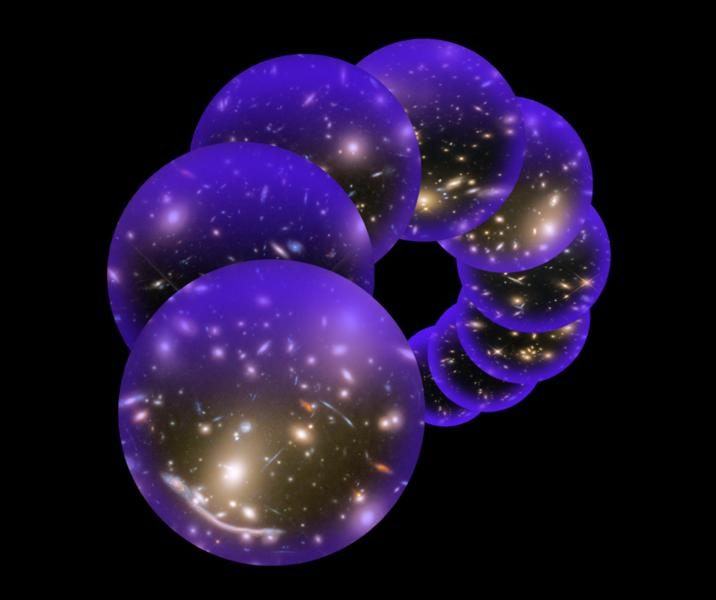
A UA-led team of scientists generated millions of different universes on a supercomputer, each of which obeyed different physical theories for how galaxies should form. NASA, ESA, and J. Lotz and the HFF Team/STScI

The models showed particularly interesting information about the role that dark matter plays in the evolution of galaxies. When the researchers created model galaxies based on the current expectations of dark matter, in which the presence of dense dark matter prevents galaxies from forming new stars early in their lives, they found the resulting galaxies appeared much redder than they do in reality. To create a model that matches what we actually perceive in the universe, the galaxies had to be adjusted so that they continued to produce stars later into their lives than expected.

“As we go back earlier and earlier in the universe, we would expect the dark matter to be denser, and therefore the gas to be getting hotter and hotter. This is bad for star formation, so we had thought that many galaxies in the early universe should have stopped forming stars a long time ago,” Behroozi explained. “But we found the opposite: Galaxies of a given size were more likely to form stars at a higher rate, contrary to the expectation.”

The findings are published in the Monthly Notices of the Royal Astronomy Society.

Georgina Torbet
Georgina has been the space writer at Digital Trends space writer for six years, covering human space exploration, planetary…
This jacket pulls drinking water straight from the air
Engineers at UT Austin have developed a wearable textile that harvests ambient moisture into drinkable water.
Image showing person wearing a jacket with special fiber that pulls water from air

Engineers at the University of Texas at Austin have built a jacket that pulls drinkable water directly from the air, offering a potential solution for hikers, soldiers, agricultural workers, and emergency responders who operate far from reliable water sources.

How the jacket collects water

Read more
Google built an AI that can see football plays before they happen
DeepMind’s latest research predicts player movement up to eight seconds into the future
Google Deepmind TacticAI Featured

Football managers spend countless hours analyzing corners, free kicks, and player positioning in search of tiny competitive advantages. Google DeepMind believes artificial intelligence can make that process significantly faster, and its latest project, TacticAI, is designed to do exactly that. TacticAI is a football-specific AI assistant capable of modeling player movement, forecasting future play dynamics, and even recommending tactical adjustments for corner kicks. One of its standout abilities is predicting player trajectories up to eight seconds into the future using only broadcast-style visual data.

TacticAI was built with Liverpool FC and validated by football experts

Read more
Radical new coffee-making method uses sound, skips hot water and reduces energy bills
UNSW reserachers brewed espresso with room-temperature water and ultrasonic sound waves, cutting energy use by 75% in blind tests that fooled 100 regular drinkers.
Person brewing espresso in a lab with a modified ultrasonic espresso machine

Researchers at UNSW Sydney have figured out how to brew espresso-strength coffee without heating any water. The method replaces hot water and high pressure with ultrasonic sound waves, and in blind taste tests involving 100 regular coffee drinkers, participants could not tell the two apart.

How it works

Read more