  1. Home
  2. Space
  3. News

NASA’s Juno spacecraft peers deep into the atmosphere of Jupiter

Add as a preferred source on Google

Researchers using NASA’s Juno probe have peered beneath Jupiter’s cloud tops to create the most detailed 3D understanding of the planet’s atmosphere to date. The research has recently been published in a series of papers in the journals Science and the Journal of Geophysical Research: Planets.

Juno, which has been orbiting Jupiter since 2016, is best known to the public for the beautiful images of the planet captured by its JunoCam. But much of this recent research was performed using another of Juno’s instruments: Its microwave radiometer (MWR) which can look through the clouds surrounding the planet and see deeper into its atmosphere.
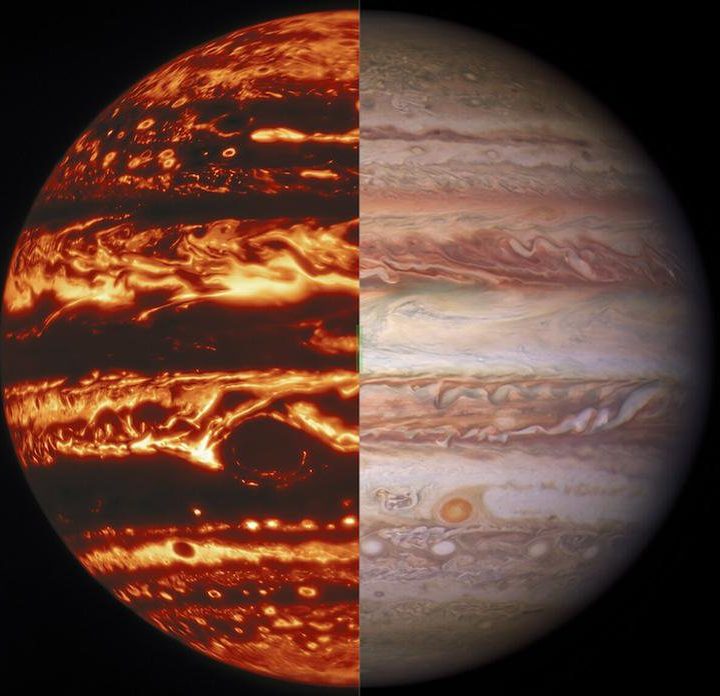
Jupiter's banded appearance is created by the cloud-forming weather layer. This composite image shows views of Jupiter in infrared and visible light taken by the Gemini North telescope and NASA's Hubble Space Telescope.
Jupiter’s banded appearance is created by the cloud-forming weather layer. This composite image shows views of Jupiter in infrared and visible light taken by the Gemini North telescope and NASA’s Hubble Space Telescope. International Gemini Observatory/NOIRLab/NSF/AURA/NASA/ESA, M.H. Wong and I. de Pater (UC Berkeley) et al.

“Previously, Juno surprised us with hints that phenomena in Jupiter’s atmosphere went deeper than expected,” said Scott Bolton, principal investigator of Juno from the Southwest Research Institute in San Antonio and lead author of one of the new papers. “Now, we’re starting to put all these individual pieces together and getting our first real understanding of how Jupiter’s beautiful and violent atmosphere works — in 3D.”

Recommended Videos

Jupiter’s atmosphere is home to huge storms which are warm and thinner on top, and cooler and denser at the bottom. These epic cyclones go as deep as 60 miles into the atmosphere. And Jupiter’s most famous storm — its impressive Great Red Spot – stretches over 200 miles wide. It is so large that researchers were able to detect changes in its velocity using instruments that study the planet’s gravity.

“The precision required to get the Great Red Spot’s gravity during the July 2019 flyby is staggering,” said Marzia Parisi, a Juno scientist from NASA’s Jet Propulsion Laboratory in Southern California and lead author of a paper in the journal Science on gravity overflights of the Great Red Spot. “Being able to complement MWR’s finding on the depth gives us great confidence that future gravity experiments at Jupiter will yield equally intriguing results.”

Other papers covered the belts of atmosphere which give the planet its distinctive look, and the strange geometric storms at its poles.

“These new observations from Juno open up a treasure chest of new information about Jupiter’s enigmatic observable features,” said Lori Glaze, director of NASA’s planetary science division at the agency’s headquarters in Washington. “Each paper sheds light on different aspects of the planet’s atmospheric processes – a wonderful example of how our internationally-diverse science teams strengthen understanding of our solar system.”

Georgina Torbet
Georgina has been the space writer at Digital Trends space writer for six years, covering human space exploration, planetary…
Scientists have found a hidden galaxy inside the Milky Way, and they’re calling it Loki
A lost dwarf galaxy may be hiding inside the Milky Way.
milky-way-hidden-galaxy-loki

Our home galaxy has a secret buried inside. A new study published in the Monthly Notices of the Royal Astronomical Society suggests that the Milky Way swallowed an ancient dwarf galaxy billions of years ago, and its stellar remains are still embedded within ours.

Researchers have named this lost galaxy Loki, after the Norse trickster god, and the name is quite fitting because it remained hidden in plain sight for a very long time.

Read more
NASA aims September launch for Roman space telescope and it’s going to be a huge shift
An earlier target for Roman means one of NASA’s most ambitious observatories is getting close, with the potential to open a huge new era in space discovery
Machine, Wheel, Astronomy

NASA is now aiming to launch the Nancy Grace Roman Space Telescope as soon as early September 2026, a faster timeline than its earlier commitment to fly no later than May 2027. That alone makes this one of the agency’s most important missions to watch over the next few months.

The reason is simple, Roman is built to scan vast parts of the sky with sharp infrared vision.

Read more
Blue Origin successfully re-uses a New Glenn rocket for the first time ever
Blue Origin achieves first New Glenn reflight despite payload setback
Blue Origin

Blue Origin has achieved a major milestone in its spaceflight ambitions by successfully reusing a booster from its heavy-lift New Glenn rocket for the first time. The historic launch, conducted on April 19, marks a significant step forward for Jeff Bezos’ space company as it seeks to compete with rivals like SpaceX in the rapidly evolving commercial launch market.

A Milestone With A Mixed Outcome

Read more