  1. Home
  2. Computing
  3. News

Nvidia’s $3,000 Project Digits puts a 1-Petaflop AI on your desk

Add as a preferred source on Google
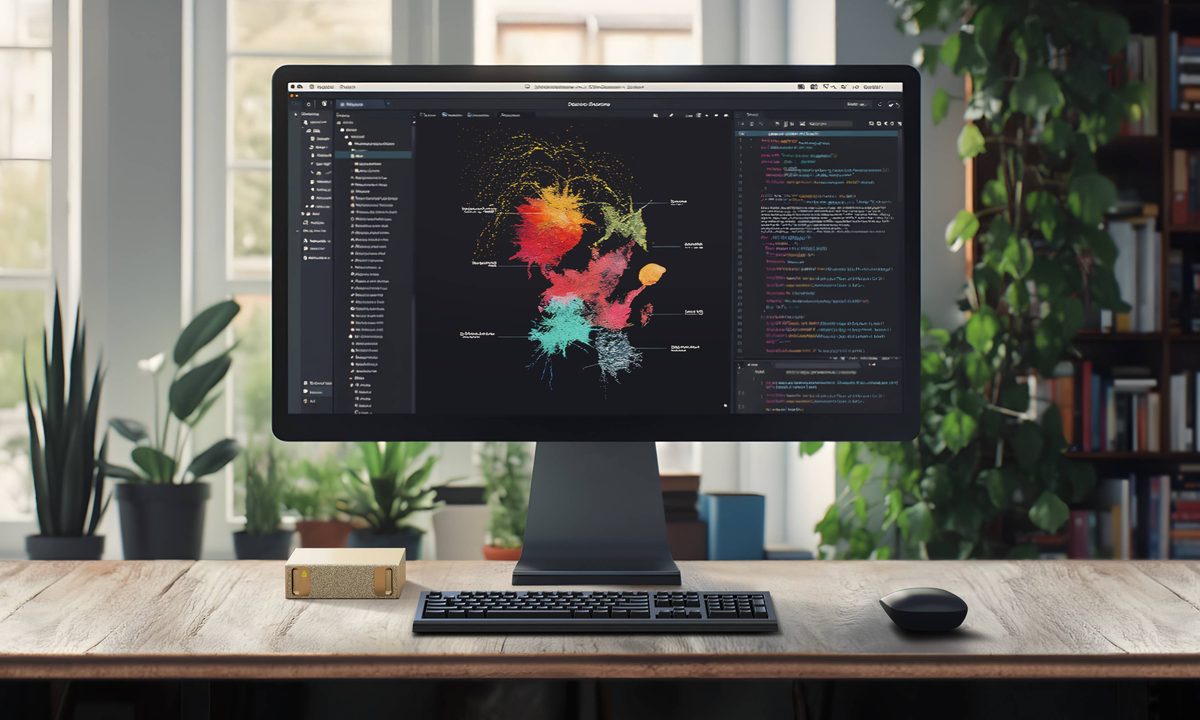
Nividia Project Digits on a desktop
Nvidia

During a 90-odd-minute keynote address at CES 2025 in Las Vegas on Monday, Nvidia CEO Jensen Huang showed off a powerful desktop computer for home AI enthusiasts. Currently going by Project Digits, this $3,000 device takes up about as much space as a Mac mini and offers 1 PFLOPS of FP4 floating point performance.

Nvidia reportedly used its DGX 100 server design as inspiration for the self-contained desktop AI, with Projects Digits being powered by a 20-core GB10 Grace Blackwell Superchip on 128GB of LPDDR5X memory with a 4TB NVMe solid-state drive (SSD).

Recommended Videos

“AI will be mainstream in every application for every industry,” Huang said during the keynote. “With Project Digits, the Grace Blackwell Superchip comes to millions of developers. Placing an AI supercomputer on the desks of every data scientist, AI researcher, and student empowers them to engage and shape the age of AI.”
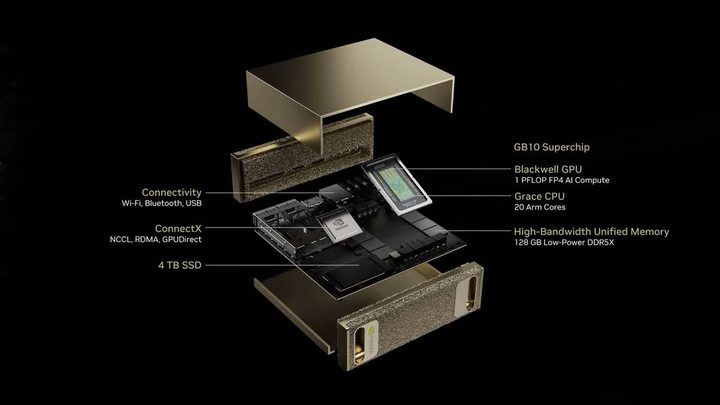
exploded image of the Project Digits components
Nvidia

Nvidia collaborated extensively with Arm to create the Grace Blackwell chip. “Our collaboration with Arm on the GB10 Superchip will fuel the next generation of innovation in AI,” Ashish Karandikar, Nvidia’s vice president of SoC Products, said in the company’s press release.

That much compute power means a Project Digits device will be able to locally run a 200-billion-iteration AI large language model (LLM) when it is scheduled for release in May. ChatGPT using the GPT-4o model, for example, is only 12-billion iterations. Digits devices can also be tethered together, increasing their theoretical max model size up to 405 billion iterations.

The company is targeting users who need full-power LLMs running locally as their primary customers for Project Digits. As such, each device comes preloaded with Nvidia’s entire AI Enterprise software stack — everything an enterprise and research outfit would need to get their AI up and running — with the idea being that users “prototype, fine-tune, and test models on local Project Digits systems” before deploying them to the cloud.

Artificial intelligence has long been criticized as a top-down technology in that its development has largely been directed by a select number of companies and institutions (specifically, those wealthy enough to afford the massive training and operating costs AI requires). This is the precise opposite of how the first computer revolution came about in the 1970s to 1990s, where uncountable legions of individual hobbyists, tinkerers, and experimentalists drove the development of personal computer technology.

Project Digits could provide the same opportunity for the AI industry. Granted, $3,000 will surely limit its initial adoption to a degree, but to be fair, people didn’t blink at the $3,500 price tag on Apple’s failed Vision Pro headset, and that thing was just a fancy display strapped to their face. If you’re interested in trying Digits for yourself, Nvidia has a notification sign-up on its website.

Andrew Tarantola
Former Computing Writer
Andrew Tarantola is a journalist with more than a decade reporting on emerging technologies ranging from robotics and machine…
Pope says AI must be disarmed and shouldn’t dominate humanity. We’re going the opposite way.
The Pope just dropped his first encyclical, and AI companies should probably read it.
Pope Leo XIV signing his first encyclical

Pope Leo XIV signed his first encyclical on May 15, the 135th anniversary of Pope Leo XIII's Rerum novarum. The document, Magnifica humanitas, was published on May 25 and addresses one of the defining challenges of our time: artificial intelligence and its impact on humanity.

The core message isn't anti-technology. The Pope is clear that technology is neither a threat nor inherently evil. However, he does say that technology is never neutral, because it takes on the values of those who build, fund, and control it. That's where things get interesting.

Read more
I built an offline Grammarly alternative and turned it into a Mac app without any coding
It lives in a browser tab. It's a Chrome extension. It's also a Mac app. Claude built it for me in all three flavors.
Grammarly alternative built using Claude.

I wrote this entire article while seated on an airplane experiencing unusually high turbulence. The software I used to spell-check and grammatically sanitize the draft was built at an airport. The language engine is running entirely on my Mac, fully offline, fixing all my typos and removing the double spaces while I mash the keyboard and sip a sugar-bomb coffee. 

Also, I don't know how to code. I didn't write a single line of code, and yet, the Mac software I am using right now looks classier and feels snappier than Grammarly ever did. Grammarly, if you don't know, is one of the most popular apps for spelling and grammar checking on the planet. So, how did I do it? I asked Claude. I narrated my wish, it asked my preferences, and in less than 30 minutes, I built myself a no-internet Grammarly replacement while also avoiding the "yet-another-subscription" curse.

Read more
China will put a unique ID code on humanoid robots, just like citizen ID for us humans
China is treating its humanoid robots like citizens. assigning each one a unique ID code from birth to recycling.
Robot with four arms

China has launched a national programme that will assign every humanoid robot manufactured in the country a unique digital identity code, effectively a citizen ID, but for bipedal machines (those that can balance and walk/run on two legs). 

The initiative, called the Humanoid Full Lifecycle Management Service Platform, was announced on Friday. It is led by the Humanoid Robotics and Embodied Intelligence Standardization committee, which is under China's Ministry of Industry and Information Technology (via South China Morning Post).

Read more