  1. Home
  2. Emerging Tech
  3. News

Black holes devour nearby stars and spew brilliant X-rays during outburst phase

Add as a preferred source on Google

Using data collected from the International Space Station (ISS), physicists have been investigating an explosion of X-ray light that originated from a black hole in an outburst phase. The data suggests that during an outburst, black holes consume huge amounts of stellar material and shrink in size by a factor of ten.

The data was gathered from a black hole named MAXI J1820+070 which was detected on March 11, 2018 using the Monitor of All-sky X-ray Image (MAXI) instrument aboard the ISS. The MAXI is an X-ray detection system which monitors for X-ray outbursts like the ones given off by black holes in their outburst phase. “This boomingly bright black hole came on the scene, and it was almost completely unobscured, so we got a very pristine view of what was going on,” Jack Steiner, a research scientist in the Massachusetts Institute of Technology (MIT)’s Kavli Institute for Astrophysics and Space Research, said in a statement.

Recommended Videos

An outburst is a phase in the evolution of a black hole in which it emits extremely energetic bursts of X-rays while absorbing vast amounts of gas and dust from a nearby star. As the black hole consumes matter, its corona — the highly energized electrons which surround the black hole — shrinks massively from around 100 kilometers in diameter (62 miles) to just 10 kilometers (6.2 miles) in a period of a month.

Once the MAXI instrument observed the outburst, scientists turned to another instrument aboard the ISS, NASA’s Neutron star Interior Composition Explorer (NICER) to obtain more details about the amount and timing of incoming X-ray photons. When a black hole consumes large amounts of matter, this material settles in the accretion disk and generates heat as it spins closer to the black hole. When the material reaches temperatures of millions of degrees, the energy shines out as X-rays.
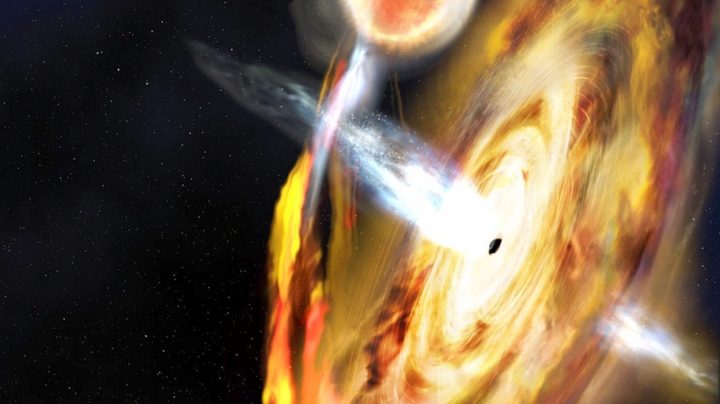
X-ray echoes, mapped by NASA’s Neutron star Interior Composition Explorer (NICER), revealed changes to the accretion disk and corona of black hole MAXI J1820+070. NASA’s Goddard Space Flight Center

“This is the first time that we’ve seen this kind of evidence that it’s the corona shrinking during this particular phase of outburst evolution,” Steiner said. “The corona is still pretty mysterious, and we still have a loose understanding of what it is. But we now have evidence that the thing that’s evolving in the system is the structure of the corona itself.”


Georgina Torbet
Georgina has been the space writer at Digital Trends space writer for six years, covering human space exploration, planetary…
Brazil’s secret World Cup weapon taught the team when to ignore it
The data said he wasn't running enough. The footage said he was always in the “perfect tactical position.”
Soccer ball in net

Brazil has more World Cup titles than anyone, five of them to be precise, but after going through five straight tournaments without adding to that count, the team is leaning hard on data this time. 

Every player wears a sensor-packed "smart vest" tracking field position (via GPS), heart rate, and a stat called "player load," the same kind of numbers that your Whoop band or Apple Watch brags about, but tuned specifically for the sport.

Read more
New OLED breakthrough could make the next see-through screen actually worth using
The electrode fix that could finally make see-through screens worth looking at.
Computer Hardware, Electronics, Hardware

Every transparent OLED demo I’ve seen so far looks amazing for about ten seconds, right before I notice how dim or smudgy it actually looks. A big part of the problem is the role that electrodes play in the design. 

A transparent display requires a see-through electrode that sits on top of incredibly delicate organic light-emitting layers. However, most of the usual options either conduct electricity poorly or risk damaging those layers during manufacturing. 

Read more
This jacket pulls drinking water straight from the air
Engineers at UT Austin have developed a wearable textile that harvests ambient moisture into drinkable water.
Image showing person wearing a jacket with special fiber that pulls water from air

Engineers at the University of Texas at Austin have built a jacket that pulls drinkable water directly from the air, offering a potential solution for hikers, soldiers, agricultural workers, and emergency responders who operate far from reliable water sources.

How the jacket collects water

Read more