  1. Home
  2. Emerging Tech
  3. Legacy Archives

Nope, that’s not a person pretending to be a Boston Dynamics robot

Add as a preferred source on Google
Boston Dynamics PETMAN
Image used with permission by copyright holder

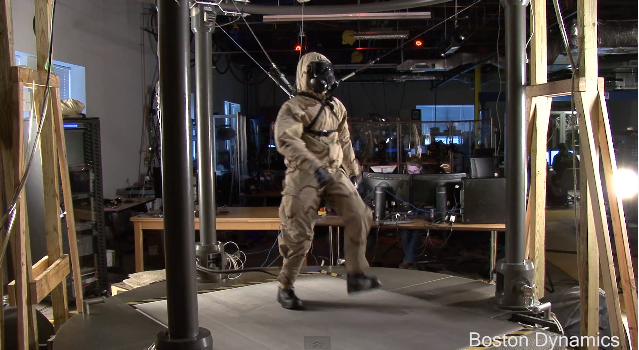
From the makers of Big Dog and Alpha Dog, Boston Dynamics has introduced an update to its humanoid robot PETMAN. In the latest video, PETMAN can walk, twist, and raise its arms as if it’s a human under that camo suit pretending to be a robot. 

The PETMAN was designed to simulate military soldiers and their movements under protective suits, though the footage makes PETMAN appear more like Boston Dymanics’ path to creating the terminator. Decked out in full battle gear, including a gas mask and chemical protection suit, the PETMAN can march, turn, and readjust its stance in a fairly fluid manner. At one point, it looks more like the PETMAN was readying itself for a tai chi session than battle.

Recommended Videos

In addition to its human-like movements, the PETMAN also comes embedded with sensors on its skin layer to detect chemicals leaking through the suit, identifying any protective gear damage. “It is used to test the performance of protective clothing designed for hazardous environments,” Boston Dynamics described on its YouTube page. Additionally, the robot can mimic properties in human sweat production to help researchers learn how to better regulate internal suit temperature. Yeah, that’s right, scientists have created a robot that knows how to sweat. Technology!

The DARPA-sponsored project, once again, is nothing short of amazing yet terrifying. The project is also funded by Department of Defense’s (DoD) Chemical and Biological Defense program, possibly paving the way for these mega robots to one day stand in line with human soldiers in combat. Imagine if the company combines Big Dog’s ability to hurl cinderblocks with PETMAN’s size and agility? We’re not gonna mess with that one.

Watch the video below to see PETMAN doing his thing.

Natt Garun
An avid gadgets and Internet culture enthusiast, Natt Garun spends her days bringing you the funniest, coolest, and strangest…
Google built an AI that can see football plays before they happen
DeepMind’s latest research predicts player movement up to eight seconds into the future
Google Deepmind TacticAI Featured

Football managers spend countless hours analyzing corners, free kicks, and player positioning in search of tiny competitive advantages. Google DeepMind believes artificial intelligence can make that process significantly faster, and its latest project, TacticAI, is designed to do exactly that. TacticAI is a football-specific AI assistant capable of modeling player movement, forecasting future play dynamics, and even recommending tactical adjustments for corner kicks. One of its standout abilities is predicting player trajectories up to eight seconds into the future using only broadcast-style visual data.

TacticAI was built with Liverpool FC and validated by football experts

Read more
Radical new coffee-making method uses sound, skips hot water and reduces energy bills
UNSW reserachers brewed espresso with room-temperature water and ultrasonic sound waves, cutting energy use by 75% in blind tests that fooled 100 regular drinkers.
Person brewing espresso in a lab with a modified ultrasonic espresso machine

Researchers at UNSW Sydney have figured out how to brew espresso-strength coffee without heating any water. The method replaces hot water and high pressure with ultrasonic sound waves, and in blind taste tests involving 100 regular coffee drinkers, participants could not tell the two apart.

How it works

Read more
This tiny sensor could help self-driving cars and robots see better in the dark
Penn State researchers have developed a light-adaptive photomemristor modeled on the human eye that achieves over 95% visual accuracy in shifting light conditions.
Waymo Jaguar I-PACE sensors close up

Penn State researchers have developed a light-adaptive sensor component that could make autonomous vehicle cameras and robots far more reliable in shifting lighting conditions. The work, published Monday in Nature Communications, takes direct cues from how the human eye adjusts between bright and dark environments.

Biology as a blueprint

Read more