  1. Home
  2. Space
  3. News

Hubble spots persistent water vapor on Europa — but only in one hemisphere

Add as a preferred source on Google

One of the most promising locations to search for life in our solar system isn’t on a planet — it’s on a moon, specifically Jupiter’s moon Europa. Now, new evidence from the Hubble Space Telescope shows that there seems to be persistent water vapor spread across one of Europa’s hemispheres, where it is being sublimated from ice on the surface. But why this vapor is only present on one side of the moon remains unclear.

Europa is particularly promising as a location to look for life because it is thought to host a liquid ocean beneath the icy crust of its surface. Previously, scientists had detected plumes of water vapor on Europa which seem to be erupting through the ice, similar to how geysers throw up water on Earth. But this recent discovery suggests there is a second source of water vapor on Europa as well.
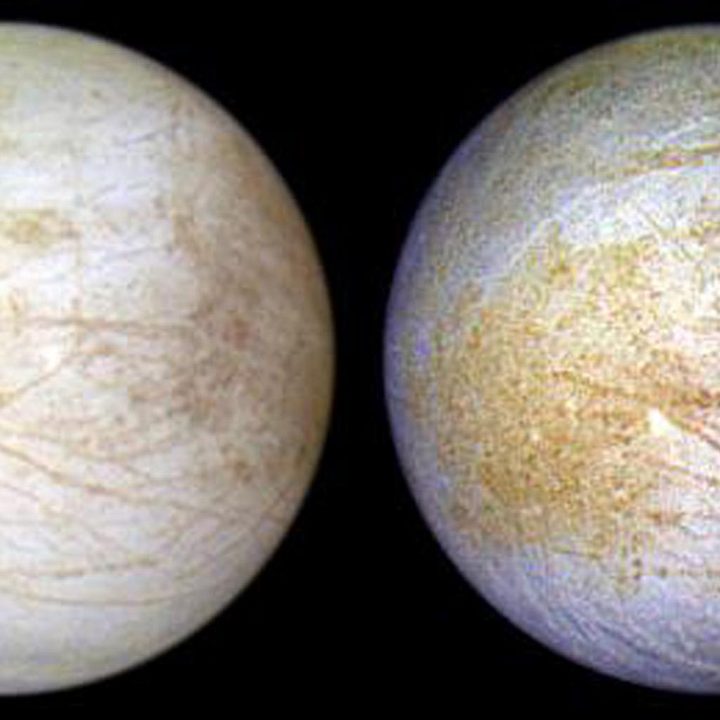
This photograph of the Jovian moon Europa was taken in June 1997 at a range of 776,700 miles by NASA’s Galileo spacecraft. NASA/JPL/University of Arizona

The recent research looked at Hubble data collected between 1999 and 2015 and found long-term presence of water vapor spread over a large area of the moon. It is present only in Europa’s trailing hemisphere, which is the half of the moon which is opposite the direction in which it is moving.

Recommended Videos

A similar analysis to the Hubble data about Europa was also recently used to find water vapor in the atmosphere of Jupiter’s moon Ganymede by the same researcher, Lorenz Roth of the KTH Royal Institute of Technology, Space and Plasma Physics, Sweden.

“The observation of water vapor on Ganymede, and on the trailing side of Europa, advances our understanding of the atmospheres of icy moons,” said Roth in a statement. “However, the detection of a stable water abundance on Europa is a bit more surprising than on Ganymede because Europa’s surface temperatures are lower than Ganymede’s.”

Roth found that, even in the chilly temperatures of -260 degrees Fahrenheit on Europa, the ice was sublimating (changing from solid to gas without becoming a liquid) in the sunlight. However, the strangest part of this phenomenon — why it is happening only on one hemisphere — remains a mystery.

To learn more about this intriguing moon, the European Space Agency’s Jupiter Icy Moons Explorer (JUICE) mission will be traveling there after its launch next year, along with NASA’s Europa Clipper mission, set to launch in 2024.

The research is published in the journal Geophysical Research Letters.

Georgina Torbet
Georgina has been the space writer at Digital Trends space writer for six years, covering human space exploration, planetary…
Scientists have found a hidden galaxy inside the Milky Way, and they’re calling it Loki
A lost dwarf galaxy may be hiding inside the Milky Way.
milky-way-hidden-galaxy-loki

Our home galaxy has a secret buried inside. A new study published in the Monthly Notices of the Royal Astronomical Society suggests that the Milky Way swallowed an ancient dwarf galaxy billions of years ago, and its stellar remains are still embedded within ours.

Researchers have named this lost galaxy Loki, after the Norse trickster god, and the name is quite fitting because it remained hidden in plain sight for a very long time.

Read more
NASA aims September launch for Roman space telescope and it’s going to be a huge shift
An earlier target for Roman means one of NASA’s most ambitious observatories is getting close, with the potential to open a huge new era in space discovery
Machine, Wheel, Astronomy

NASA is now aiming to launch the Nancy Grace Roman Space Telescope as soon as early September 2026, a faster timeline than its earlier commitment to fly no later than May 2027. That alone makes this one of the agency’s most important missions to watch over the next few months.

The reason is simple, Roman is built to scan vast parts of the sky with sharp infrared vision.

Read more
Blue Origin successfully re-uses a New Glenn rocket for the first time ever
Blue Origin achieves first New Glenn reflight despite payload setback
Blue Origin

Blue Origin has achieved a major milestone in its spaceflight ambitions by successfully reusing a booster from its heavy-lift New Glenn rocket for the first time. The historic launch, conducted on April 19, marks a significant step forward for Jeff Bezos’ space company as it seeks to compete with rivals like SpaceX in the rapidly evolving commercial launch market.

A Milestone With A Mixed Outcome

Read more