  1. Home
  2. Space
  3. News

See the surface of Jupiter’s icy moon Europa in unprecedented detail

Add as a preferred source on Google

Jupiter’s icy moon Europa is a fascinating place and is of particular interest to astronomers for several reasons. It is known to host both water vapor and table salt, and has been suggested as being one of the locations in our solar system most likely to be hospitable to life thanks to its water-ice crust and a thin oxygen atmosphere.

NASA plans to send the Europa Clipper mission to the moon, launching in 2025, to search for subsurface lakes and evidence of recent water eruptions there. The European Space Agency’s JUICE mission to Ganymede will also perform two flybys of Europa after it launches in 2022.

Recommended Videos

Until those missions launch, however, scientists are making do with nearly 20-year-old images collected by NASA’s Galileo spacecraft in the late 1990s. By re-processing the data from this mission using modern image-processing techniques, they have been able to reveal new details in these old images.
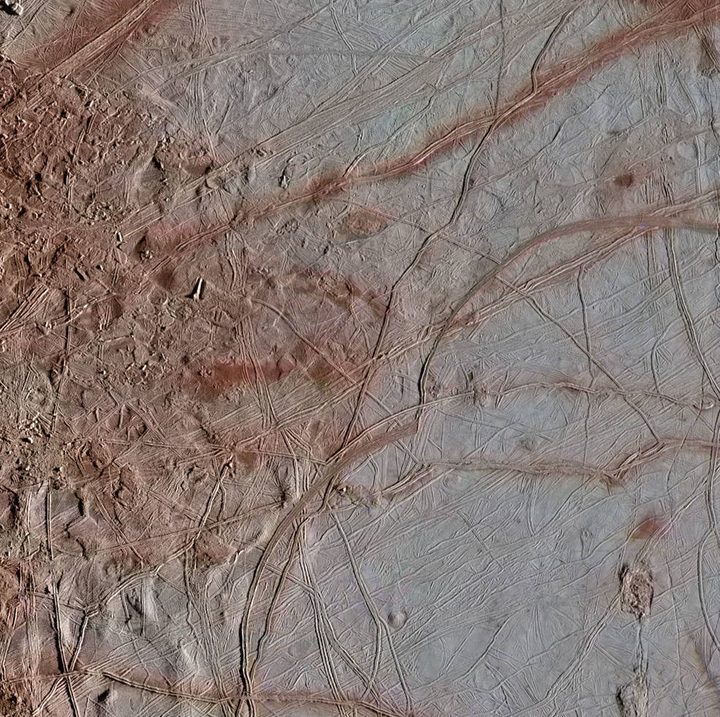
newly reprocessed Europa image
In newly reprocessed Europa images, details are visible in the variety of features on the moon’s icy surface. This image of an area called Chaos Transition shows blocks that have moved and ridges possibly related to how the crust fractures from the force of Jupiter’s gravity. NASA/JPL-Caltech/SETI Institute

By enhancing the colors of the images, the scientists were able to see geological features like different chemical compositions on the moon’s surface. The white-blue areas indicate pure water ice, while the red-brown sections indicate the presence of other compounds such as salts.

The bands and ridges are believed to be created in the ice surface by the movements of the hypothesized ocean beneath. The sloshing of the ocean causes movements similar to plate tectonics here on Earth, causing pressure on the surface which pushes the ice into these formations.

There are also areas referred to by the delightful term “chaos terrain” in which blocks of ice have come loose and then shifted or rotated before being re-frozen.

image of an area called Crisscrossing Bands
This image of an area called Crisscrossing Bands shows ridges, which may form when a crack in the surface opens and closes repeatedly. In contrast, the smooth bands shown here form where a crack continues pulling apart horizontally, producing large, wide, relatively flat features. NASA/JPL-Caltech/SETI Institute

We’ll learn a lot more about this mysterious moon in the next decades with the launch of the new missions. “We’ve only seen a very small part of Europa’s surface at this resolution,” planetary geologist Cynthia Phillips of NASA’s Jet Propulsion Laboratory said in a statement. “Europa Clipper will increase that immensely.”

Georgina Torbet
Georgina has been the space writer at Digital Trends space writer for six years, covering human space exploration, planetary…
Scientists have found a hidden galaxy inside the Milky Way, and they’re calling it Loki
A lost dwarf galaxy may be hiding inside the Milky Way.
milky-way-hidden-galaxy-loki

Our home galaxy has a secret buried inside. A new study published in the Monthly Notices of the Royal Astronomical Society suggests that the Milky Way swallowed an ancient dwarf galaxy billions of years ago, and its stellar remains are still embedded within ours.

Researchers have named this lost galaxy Loki, after the Norse trickster god, and the name is quite fitting because it remained hidden in plain sight for a very long time.

Read more
NASA aims September launch for Roman space telescope and it’s going to be a huge shift
An earlier target for Roman means one of NASA’s most ambitious observatories is getting close, with the potential to open a huge new era in space discovery
Machine, Wheel, Astronomy

NASA is now aiming to launch the Nancy Grace Roman Space Telescope as soon as early September 2026, a faster timeline than its earlier commitment to fly no later than May 2027. That alone makes this one of the agency’s most important missions to watch over the next few months.

The reason is simple, Roman is built to scan vast parts of the sky with sharp infrared vision.

Read more
Blue Origin successfully re-uses a New Glenn rocket for the first time ever
Blue Origin achieves first New Glenn reflight despite payload setback
Blue Origin

Blue Origin has achieved a major milestone in its spaceflight ambitions by successfully reusing a booster from its heavy-lift New Glenn rocket for the first time. The historic launch, conducted on April 19, marks a significant step forward for Jeff Bezos’ space company as it seeks to compete with rivals like SpaceX in the rapidly evolving commercial launch market.

A Milestone With A Mixed Outcome

Read more