  1. Home
  2. Space
  3. News

James Webb Space Telescope launched on mission to uncover secrets of the universe

Add as a preferred source on Google

A new era in astronomy is underway, with the successful launch today of the world’s most powerful space telescope. The James Webb Space Telescope blasted off safely early this morning after long delays and great anticipation.
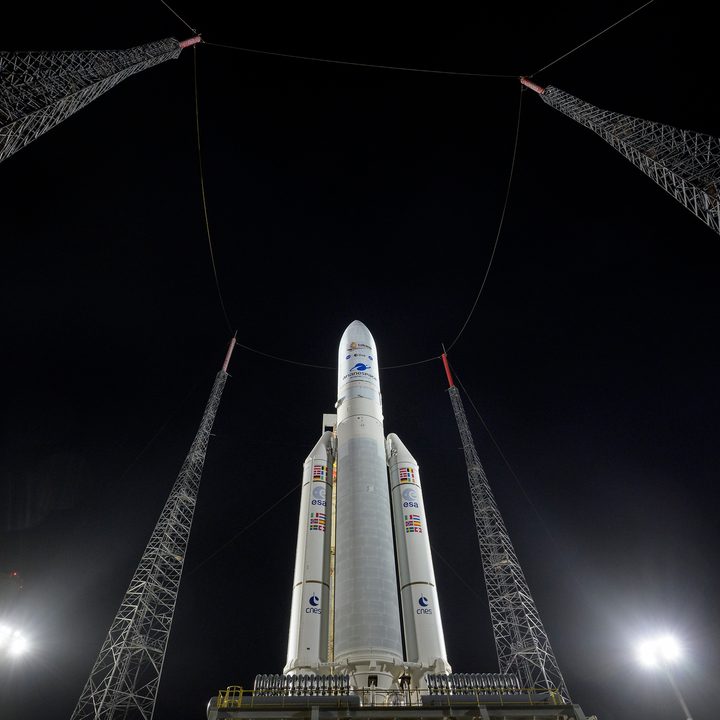
Arianespace's Ariane 5 rocket with NASA’s James Webb Space Telescope onboard, is seen at the launch pad, Thursday, Dec. 23, 2021, at Europe’s Spaceport, the Guiana Space Center in Kourou, French Guiana.
Arianespace’s Ariane 5 rocket with NASA’s James Webb Space Telescope onboard, is seen at the launch pad, Thursday, Dec. 23, 2021, at Europe’s Spaceport, the Guiana Space Center in Kourou, French Guiana. NASA

The telescope was launched by an Ariane 5 rocket from Europe’s Spaceport in Kourou, French Guiana at 7:20 a.m. ET on Saturday, December 25. It is a joint collaboration between NASA, the European Space Agency, and the Canadian Space Agency, and is intended as a successor to the beloved Hubble Space Telescope. For now, Hubble will continue operations, gathering data primarily in the visible light wavelength, while James Webb will focus mostly on observations in the infrared wavelength.

Recommended Videos

James Webb is armed with cutting-edge science instruments and, as it does not have to peer through the atmosphere of Earth as ground-based telescopes do, it will be able to see cosmic phenomena in greater detail than ever before. This will allow it to be used to perform research on a wide variety of topics, from examining black holes, to looking at some of the most ancient galaxies, to investigating exoplanets to see whether they have atmospheres.

“Its scientific promise is breathtaking,” wrote Thomas Zurbuchen, associate administrator for NASA’s Science Mission Directorate, this summer. “Discoveries ranging from imaging the first galaxies in the universe, analyzing the atmospheres of planets orbiting other stars in our galaxy, and even making discoveries in our solar system — the Webb space telescope is a dream come true for astronomers and science fans alike.”

Before Webb can begin its scientific explorations, however, the telescope needs to be positioned and its instruments checked. Within a week the telescope will unfold its tennis-court-sized sunshield which will protect the telescope from the heat and radiation of the sun. The telescope is currently traveling through space on its way to its final location orbiting the sun, in a position called the second Lagrange point.

Webb will then need to test out its instruments, which will be turned on one at a time. The telescope’s mirrors also need to be adjusted, and Webb should be able to capture high-quality images within a few months. With the instruments check and calibrated, Webb should be able to begin its science mission in around six months’ time.

Georgina Torbet
Georgina has been the space writer at Digital Trends space writer for six years, covering human space exploration, planetary…
Scientists have found a hidden galaxy inside the Milky Way, and they’re calling it Loki
A lost dwarf galaxy may be hiding inside the Milky Way.
milky-way-hidden-galaxy-loki

Our home galaxy has a secret buried inside. A new study published in the Monthly Notices of the Royal Astronomical Society suggests that the Milky Way swallowed an ancient dwarf galaxy billions of years ago, and its stellar remains are still embedded within ours.

Researchers have named this lost galaxy Loki, after the Norse trickster god, and the name is quite fitting because it remained hidden in plain sight for a very long time.

Read more
NASA aims September launch for Roman space telescope and it’s going to be a huge shift
An earlier target for Roman means one of NASA’s most ambitious observatories is getting close, with the potential to open a huge new era in space discovery
Machine, Wheel, Astronomy

NASA is now aiming to launch the Nancy Grace Roman Space Telescope as soon as early September 2026, a faster timeline than its earlier commitment to fly no later than May 2027. That alone makes this one of the agency’s most important missions to watch over the next few months.

The reason is simple, Roman is built to scan vast parts of the sky with sharp infrared vision.

Read more
Blue Origin successfully re-uses a New Glenn rocket for the first time ever
Blue Origin achieves first New Glenn reflight despite payload setback
Blue Origin

Blue Origin has achieved a major milestone in its spaceflight ambitions by successfully reusing a booster from its heavy-lift New Glenn rocket for the first time. The historic launch, conducted on April 19, marks a significant step forward for Jeff Bezos’ space company as it seeks to compete with rivals like SpaceX in the rapidly evolving commercial launch market.

A Milestone With A Mixed Outcome

Read more