  1. Home
  2. Space
  3. News

James Webb Space Telescope powers on its instruments in Ground Segment Test

Add as a preferred source on Google

NASA’s upcoming James Webb Space Telescope has run into its share of problems during its development process, but now it has reached a milestone with the completion of the “Ground Segment Test.”

This test involved sending commands to power on the scientific instruments aboard the James Webb for the first time, ensuring that ground control personnel at NASA will be able to control the telescope once it is in orbit.

Recommended Videos

“This was the first time we have done this with both the actual Webb flight hardware and ground system,” Amanda Arvai, deputy division head of mission operations at the Space Telescope Science Institute (STScI) in Maryland said in a statement.

“We’ve performed pieces of this test as the observatory was being assembled, but this is the first ever, and fully successful, end-to-end operation of the observatory and ground segment. This is a big milestone for the project, and very rewarding to see Webb working as expected.”
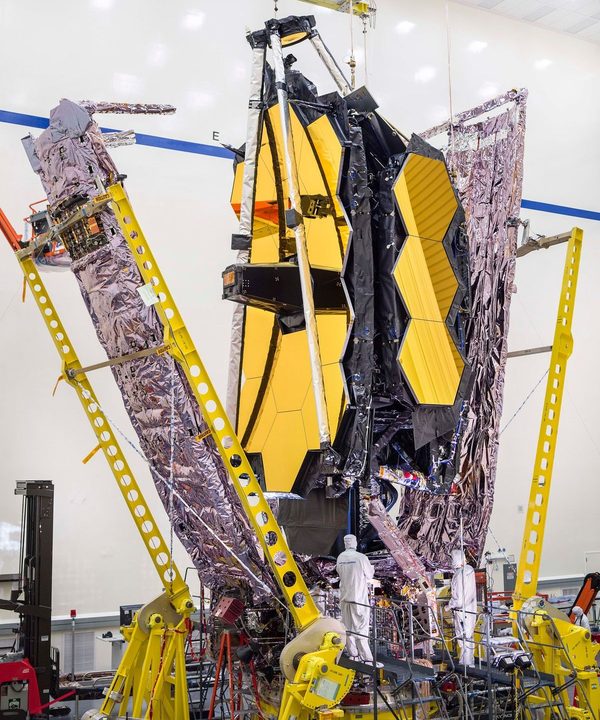
Now that the observatory has been completely assembled, Webb teams are running full observatory level tests to ensure it is prepared for the rigors of liftoff.
Now that the observatory has been completely assembled, Webb teams are running full observatory level tests to ensure it is prepared for the rigors of liftoff. NASA/Chris Gunn

The test required over 100 people, most working remotely, and took four days. It consisted of turning on, moving, and operating the telescope’s four instruments: The Near-Infrared Camera, the Near-Infrared Spectrograph, the Mid-Infrared Instrument, and the Fine Guidance Sensor/Near InfraRed Imager and Slitless Spectrograph.

“This was also the first time we’ve demonstrated the complete cycle for conducting observations with the observatory’s science instruments,” Arvai said.

“This cycle starts with the creation of an observation plan by the ground system which is uplinked to the observatory by the Flight Operations Team. Webb’s science instruments then performed the observations and the data was transmitted back to the Mission Operations Center in Baltimore, where the science was processed and distributed to scientists.”

The engineers wanted to simulate the communications conditions of the telescope being in space and being controlled from the ground, so they sent the commands via NASA’s Deep Space Network. Once the telescope is in orbit, commands will be relayed using the network which has locations in California, Spain, and Australia to ensure that communication with space-based instruments can continue as the Earth rotates.

Testing of the James Webb will continue with acoustic and sine-vibration testing which simulate the challenging conditions of a launch, and the launch itself is scheduled for October 31, 2021.

Georgina Torbet
Georgina has been the space writer at Digital Trends space writer for six years, covering human space exploration, planetary…
Scientists have found a hidden galaxy inside the Milky Way, and they’re calling it Loki
A lost dwarf galaxy may be hiding inside the Milky Way.
milky-way-hidden-galaxy-loki

Our home galaxy has a secret buried inside. A new study published in the Monthly Notices of the Royal Astronomical Society suggests that the Milky Way swallowed an ancient dwarf galaxy billions of years ago, and its stellar remains are still embedded within ours.

Researchers have named this lost galaxy Loki, after the Norse trickster god, and the name is quite fitting because it remained hidden in plain sight for a very long time.

Read more
NASA aims September launch for Roman space telescope and it’s going to be a huge shift
An earlier target for Roman means one of NASA’s most ambitious observatories is getting close, with the potential to open a huge new era in space discovery
Machine, Wheel, Astronomy

NASA is now aiming to launch the Nancy Grace Roman Space Telescope as soon as early September 2026, a faster timeline than its earlier commitment to fly no later than May 2027. That alone makes this one of the agency’s most important missions to watch over the next few months.

The reason is simple, Roman is built to scan vast parts of the sky with sharp infrared vision.

Read more
Blue Origin successfully re-uses a New Glenn rocket for the first time ever
Blue Origin achieves first New Glenn reflight despite payload setback
Blue Origin

Blue Origin has achieved a major milestone in its spaceflight ambitions by successfully reusing a booster from its heavy-lift New Glenn rocket for the first time. The historic launch, conducted on April 19, marks a significant step forward for Jeff Bezos’ space company as it seeks to compete with rivals like SpaceX in the rapidly evolving commercial launch market.

A Milestone With A Mixed Outcome

Read more