
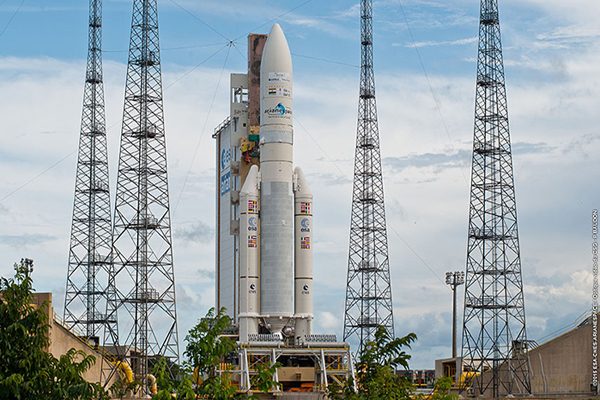
The James Webb Space Telescope might be nearly ready to be sent into space, but an issue with its launch vehicle could see the launch delayed from its October date.
The telescope is to be launched using an Ariane 5 rocket, a French launch vehicle which has historically been highly reliable. However, the company that makes the Ariane 5, Arianespace, confirmed to SpaceNews that there were issues with the separation of the fairing on two recent launches of the rocket. The fairing is the nose cone that protects the payloads inside the rocket from the extreme heat and pressure experienced during a launch. Fairings are typically constructed of two halves, which split apart once the rocket has reached high enough altitude that the extra protection is no longer required. They then fall away from the rocket.
According to the European Space Agency, the Ariane 5’s fairing, which measures over 5 meters in diameter, is “split by two pyrotechnical commands and jettisoned more than 3 minutes after liftoff, at an altitude above 100 km [62 miles].”
Arianespace did not give further details on what exactly the issue with the fairing separation was, although the affected launches were successful and the payloads were not damaged. But given how expensive and delicate the James Webb telescope is, any potential issue is a cause for concern.
“We have decided to conduct a set of additional checks with [Aerospace engineering company] RUAG and ArianeGroup to ensure the best level of quality and reliability; the progress of these investigations remains positive,” Arianespace told SpaceNews.
The aim is for the telescope to launch on an Ariane 5 in October this year, though some experts think that this date may now need to be delayed. There are two scheduled Ariane 5 launches between now and then, so these could provide more information about the state of the rocket.
The good news is that, unlike other missions, like those to Mars, the telescope does not need to launch at a particular time. A Mars mission has a strict launch window because Mars and Earth are only near to each other once every two years, so if a mission misses its window — like the European and Russian ExoMars mission did last summer due to coronavirus — it must be delayed by two whole years. But the telescope will be launched into a solar orbit, at what is called a Lagrange point. This is an orbit that is stable between the sun and the Earth, essentially allowing the telescope to be “parked,” so the launch can go ahead at any time.
However, the launch date for telescope has been pushed back multiple times, and delaying it further could add to frustrations with the pace of the project.


