
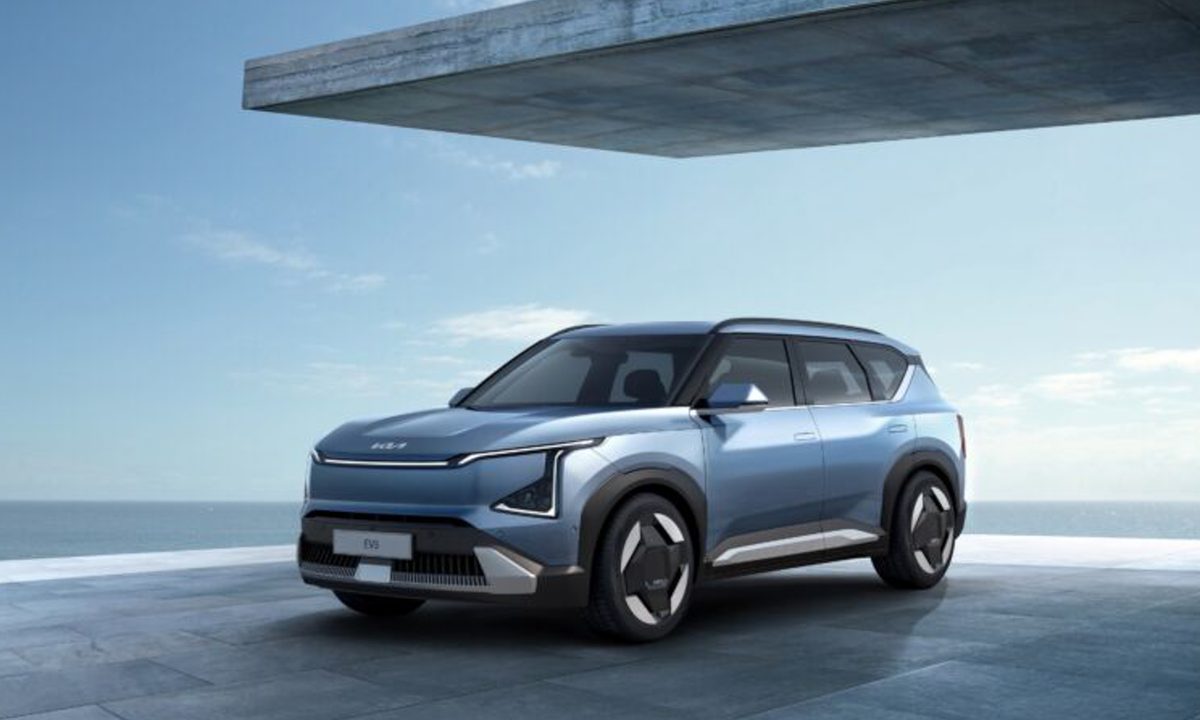
Kia is expanding its EV lineup in a big way. The company is currently in the middle of rolling out the EV3, which is now available in Europe and is likely to come to the U.S. next year. Not only that, but it’s also prepping the EV4, which it will likely announce more widely in 2025. And it’s not stopping there either — the Kia EV5 is a slightly scaled-back version of the much-loved EV9 SUV, and not only is it a vehicle we’re excited about, but it’s one that has already launched in Australia.
If the EV5 is anything like the EV9 — only cheaper — it’ll be an instant success. Curious about whether the EV5 could be your next car? Here’s everything we know about the EV5.
Design
Despite the lower number, the Kia EV5 is actually larger than the EV6 crossover — but not quite as large as the EV9 SUV. Kia calls it a “compact SUV” that offersa boxy design that’s similar to the EV9, but with only two rows of seats instead of three.
The vehicle follows a similar overall design language as the EV9, which certainly isn’t a bad thing. It has a blocky design with unique LED light signatures at both the front and the back. It has a length of 181.7 inches, which makes it a little less long than the EV6, but thanks to a much taller height, it has more interior space.

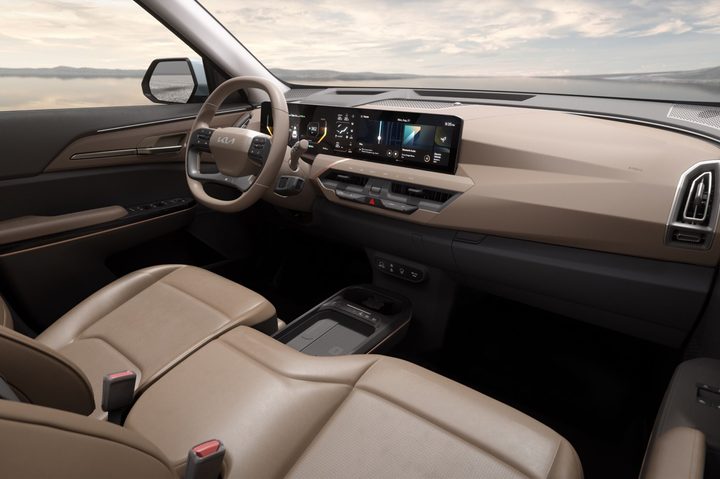
The interior design follows that of other Kia cars too. The vehicle has two 12.3-inch displays at the front of the car, one for infotainment and the other for instrument monitoring. The model being sold in Australia has a traditional five-seat layout with two front seats and three second-row seats. If the EV5 ever makes it to the U.S., that’s likely what we’ll see there too. Kia has shown off renders of a version of the EV5 with a front-row bench seat, expanding the number of seats to six, including the driver. We’ll have to see exactly how Kia approaches different models for different markets.
Tech features
The EV5 comes with a range of tech features to make the experience of using the car even better. As you would expect, you’ll get basics like backup cameras, as well as adaptive cruise control and lane-centering tech that will combine to make for a somewhat autonomous experience on the highway. Also like other Kia cars, the car offers CarPlay and Android Auto through a wireless connection. It’s hard to know which of these features will make their way to a U.S. model, if a U.S. model is indeed in the works.
Models
There are currently four trims on offer for the 2025 Kia EV5 that’s being sold in Australia. There’s the Kia EV5 Air, which is available as a standard range or a long-range version, along with the EV5 Earth and the EV5 GT-Line. The Air has a single motor that powers the two front wheels, while the Earth and the GT-Line models are both dual-motor all-wheel drive variants.
If the EV5 gets a wider release, it’s likely we’ll see other models, including a potential EV5 GT model that puts performance above all else. We’ll have to wait and see if that happens, though.
Charging speed and range
The range on offer by the Kia EV5 is pretty good, though not necessarily incredible. The lowest-range EV5 model is the EV5 Air standard range, which gets 400 kilometers or around 250 miles. The longest-range model currently being sold is the EV5 Air long range, which gets 555 kilometers, or around 345 miles. Keep in mind, however, that these range estimates are Worldwide Harmonized Light Vehicle Test Procedure (WLTP) range estimates, and generally speaking, the Environmental Protection Agency (EPA) in the U.S. is a little stricter and will likely estimate a lower range.
Kia has previously said that the EV5 would get a huge 447-mile range, so we’ll have to see if it ends up releasing an ultra-long-range model at some point.
While Kia originally said that the EV5 would not get the superfast 800-volt architecture that enables 350-kilowatt charging speeds, the model being sold in Australia does have the 800-volt architecture. We’re hoping that remains true across all iterations of the EV5, as it means that the vehicle can charge much faster.
Price and tax credit status
It seems as though Kia’s naming scheme has less to do with size, and more to do with price. We’re expecting the EV5 to be a little cheaper than the EV6, meaning that it’ll hopefully start at around $40,000 if it gets a U.S. release. In Australia, the EV5 starts at $56,770 Australian dollars, which equates to around $36,583 in the U.S. That’s very inexpensive, though it’s likely it’ll be a little more than that.
There are conflicting reports as to whether or not the EV5 will be sold in the U.S. It doesn’t seem as though the company plans to build the car at its U.S. plant — which means that it won’t qualify for the federal EV tax credit. Some reports suggest that the car won’t come to the U.S., while others note that it will be sold in North America. Both could be true, if it’s sold in Mexico and/or Canada. Hopefully, it will make its way stateside, but if it does, it likely won’t be for a few more years.
It could still get a much wider release outside of the U.S. though. Currently, Kia is manufacturing the EV5 in China, which is largely why it won’t import the vehicle to the U.S. right now given tariffs imposed on Chinese-made electric vehicles.


