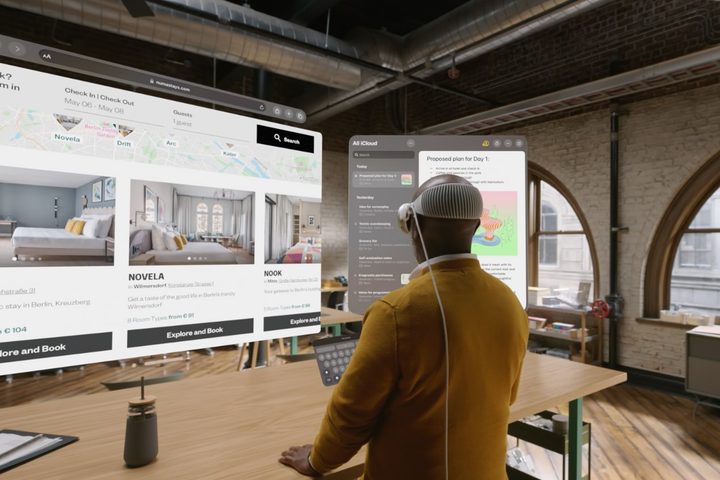
In its initial demo videos, Apple showed people using the Vision Pro with multiple floating screens and a virtual keyboard laid out in front of them. That effectively made it feel like a proper computer — a virtual Mac, so to speak.
However, we’ve now just learned that the floating keyboard could be totally absent on launch day, removing a major component of the whole setup. That’s what the latest report from Bloomberg insider Mark Gurman claims, at least. Let’s dig in.
Not ready for prime time
In a post on X (formerly Twitter), Gurman described the virtual keyboard as “a complete write-off” in the initial version of Apple’s visionOS software. He also made no mention of the keyboard in his Power On newsletter explaining how Apple will demonstrate the headset to customers, which suggests it could be totally absent on launch day.
From Gurman’s description on X: “You have to poke each key one finger at a time like you did before you learned how to type. There is no magical in-air typing. You can also look at a character and pinch.” That sounds so bad that it likely won’t be worth the effort. As Gurman put it, “You’ll want a Bluetooth keyboard.”
The Vision Pro virtual keyboard is a complete write-off at least in 1.0. You have to poke each key one finger at a time like you did before you learned how to type. There is no magical in-air typing. You can also look at a character and pinch. You’ll want a Bluetooth keyboard.
— Mark Gurman (@markgurman) January 12, 2024
To be fair to Apple, the Vision Pro contains so many new technologies that even a company of Apple’s gargantuan size would understandably struggle to get everything perfectly lined up in time for launch day. But I’ve long been curious as to whether the Vision Pro can truly replace my Mac, and this development suggests it won’t for the foreseeable future.
To be honest, if the Vision Pro can’t replace my Mac, I was expecting the reason would come down to some complex task that Apple’s headset isn’t quite ready for, such as fast-paced gaming or high-grade mathematical workloads. For the device to fall short because of an underdeveloped virtual keyboard is pretty disappointing.
Rest assured, we won’t see this lackluster keyboard when the Vision Pro launches on February 2. If Apple can’t fix it in the two weeks until release day — and right now, I don’t think it’ll be able to — the keyboard won’t appear until Apple gets it right. The tech giant is not the sort of company to deliberately include buggy or unfinished features in its products if it can help it.
And that means we could be deprived of any kind of virtual, in-air typing, at least for the time being. That’s a real shame, because features like that — those that feel natural and fit in with the ways we are used to using our tech — are what will help integrate the Vision Pro into people’s everyday lives. Considering how much of a tough sell a $3,500 virtual reality headset already will be for Apple, you’d think it would need as many features like that as possible.
A Mac replacement

In his Power On newsletter, Gurman explained that Apple will spend around 25 minutes showing each potential customer who has signed up for a demo how to use the Vision Pro. Users’ heads will be scanned to ensure the correct fit, then Apple will walk them through key features like spatial photos, multiple-window setups, integrated apps, and more.
The strange part of that is it seems Apple still wants to show people that the headset can be used as a computer replacement — arranging multiple windows and browsing apps like Safari certainly fits into that idea — but it might have to do so without the use of the virtual keyboard that was so prominently demonstrated in Apple’s teaser videos.
That suggests that Apple still thinks the Vision Pro can hold its own as a computer of sorts, and maybe even one that can replace your Mac in certain situations. And while a virtual keyboard is not essential to that, it would at least add some wow factor to the device. After all, a vital part of the Vision Pro is controlling everything without any peripherals — you use your eyes and fingers to locate and open apps, after all. Without the virtual keyboard, that proposition becomes a little weaker.
Ultimately, I don’t think this is going to slow Apple down too much, though. There’s little doubt that the company’s developers are going hell-bent for leather to get the in-air typing feature finished as soon as possible. But its initial absence just goes to show how hard the device has to work to be able to genuinely replace your Mac any time soon.