  1. Home
  2. Emerging Tech
  3. Computing
  4. News

University student builds AI system to create new baby names, hilarity ensues

Add as a preferred source on Google

Blessed with a little bundle of joy, but not sure what to name him or her? Then why not let an algorithm do it?

That is the basis for an intriguing experiment by coder and Brown University student Nate Parrott, who has created an artificial neural network that remixes everyday baby names into whole new creations.

Recommended Videos

“I trained an AI algorithm to read 7,500 common American baby names, encode them into numbers, and decode them back into the original names,” Parrott told Digital Trends. “Since every name has to be encoded as just a few numbers, the encoder learns to remove the common sounds that names have, and the decoder learns to add them back. It lets you blend names together, ‘add’ and ‘subtract’ them — and by feeding in random numbers, make up plausible-sounding names.”

Not all the names are entirely plausible, mind you.

“There’s a couple normal-sounding ones like Rosele and Halden that I like — but I’m honestly a bigger fan of the really strange ones like Pruliaaa, Onni or Kattt,” Parrott continued. “It has a weird tendency to repeat letters way too many times near the end of names and I think it’s kinda cute.”
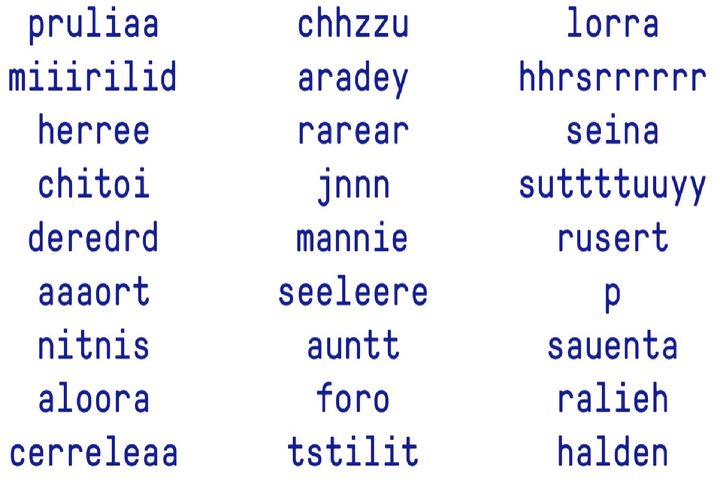
Image used with permission by copyright holder

Parrott said that he started the project because he was interested in the way that deep learning algorithms are “good at dealing with loosely defined things,” and wanted to see how they would handle naming conventions.

“Hopefully this inspires more creative people to get into computer science or machine learning,” he said. “There’s so much potential for creative uses of AI, and we’ve barely scratched the surface. Of course, if someone actually gives their kid one of these names, I’d be super excited, too. And a bit shocked, and kind of guilty.”

Still, it’s more original than naming your baby after the year’s top sports star, pop singer, or best-looking Digital Trends writer, right? (To be fair, that latter would still be somewhat original.)

To find out more about the project, you can check out Parrott’s original post about it here.

Luke Dormehl
I'm a UK-based tech writer covering Cool Tech at Digital Trends. I've also written for Fast Company, Wired, the Guardian…
This tiny sensor could help self-driving cars and robots see better in the dark
Penn State researchers have developed a light-adaptive photomemristor modeled on the human eye that achieves over 95% visual accuracy in shifting light conditions.
Waymo Jaguar I-PACE sensors close up

Penn State researchers have developed a light-adaptive sensor component that could make autonomous vehicle cameras and robots far more reliable in shifting lighting conditions. The work, published Monday in Nature Communications, takes direct cues from how the human eye adjusts between bright and dark environments.

Biology as a blueprint

Read more
A chemical bath could bring your old EV battery back to near-full strength
Cornell researchers have developed a recycling process that restores spent lithium-ion cells to 95% of their original capacity while cutting recycling costs by more than half.
Li-ion battery close up showing recycling symbol

Your next phone or EV could run on a recycled battery that performs nearly as well as a new one. Cornell University researchers have developed a new recycling technique that restores spent lithium-ion cells to up to 95% of their original capacity, while cutting recycling costs by 56%.

A bath instead of a shredder

Read more
The best new ChatGPT feature is one most people will never use
Logo, Emblem, Symbol

For years, the biggest conversation around AI has been what these tools can do. They can browse the web, analyze documents, connect to your apps, conduct research, and increasingly act on your behalf. But as AI systems become more capable, another question has become harder to ignore: what happens when an AI assistant is tricked into handing over information it shouldn’t?

OpenAI’s new Lockdown Mode is its latest answer to that problem. Available across all ChatGPT account types, Lockdown Mode is an optional security setting designed for people and organizations handling sensitive information. The trade-off is that you get stronger protection against certain forms of data theft, but you lose access to some of ChatGPT’s most powerful features.

Read more