  1. Home
  2. Space
  3. News

X-ray data from Chandra gives a new view of Webb’s first images

Add as a preferred source on Google

This week has been a fun time for telescope team-ups, with a recent project combining data from the James Webb and Hubble Space Telescopes. There’s also a second set of images that has been released that combines data from the James Webb Space Telescope and the Chandra X-ray Observatory.

The Chandra observatory, which is also a space-based telescope, looks in the X-ray wavelength to investigate phenomena like epic kilonova explosions, search for the universe’s missing matter, and capture stunning images of the universe as seen in X-ray observations. It has even been used to detect a possible exoplanet in the Whirlpool galaxy. Now, it has turned its sights on the targets of James Webb’s first images to show these now-famous objects in a new light.
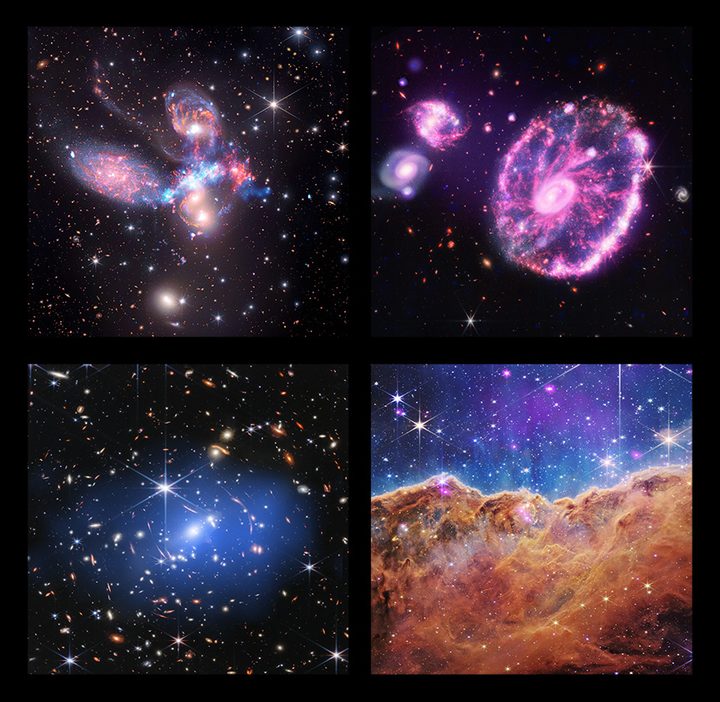
X-rays from Chandra have been combined with infrared data from early publicly-released James Webb Space Telescope images.
X-rays from Chandra have been combined with infrared data from early publicly-released James Webb Space Telescope images. Credit: X-ray: NASA/CXC/SAO; IR (Spitzer): NASA/JPL-Caltech; IR (Webb): NASA/ESA/CSA/STScI

Clockwise from top left, these images show Stephan’s Quintet, the Cartwheel Galaxy, the Carine Nebula, and the first Webb deep field. The Chandra X-ray data has been added to the original images in shades of blue and purple, picking out the X-rays being given off by things like extremely hot gas, bright young stars, or by black holes or neutron stars which are feeding on nearby sources of matter.

Recommended Videos

Compared to Webb’s infrared view, Chandra observes even higher energy X-rays, which are given off by very high energy processes. By looking at both of these wavelengths, astronomers can pick out phenomena which would otherwise be invisible. In Stephan’s Quintet, for example, a group of five close galaxies, the Chandra data revealed a shockwave caused by two of the galaxies colliding into each other at 2 million miles per hour. This shockwave is heating up gas to tens of millions of degrees. In the Carina Nebula image, the X-rays shown in purple pick out some of the hottest and most massive young stars.

These images show that, as powerful as Webb is alone, it is becomes even more so when used along with other tools. “[Webb] is designed to work in concert with NASA’s many other telescopes as well as facilities both in space and on the ground,” NASA said. “These new versions of Webb’s first images combine its infrared data with X-rays collected by NASA’s Chandra X-ray Observatory, underscoring how the power of any of these telescopes is only enhanced when joined with others.”

Georgina Torbet
Georgina has been the space writer at Digital Trends space writer for six years, covering human space exploration, planetary…
Scientists have found a hidden galaxy inside the Milky Way, and they’re calling it Loki
A lost dwarf galaxy may be hiding inside the Milky Way.
milky-way-hidden-galaxy-loki

Our home galaxy has a secret buried inside. A new study published in the Monthly Notices of the Royal Astronomical Society suggests that the Milky Way swallowed an ancient dwarf galaxy billions of years ago, and its stellar remains are still embedded within ours.

Researchers have named this lost galaxy Loki, after the Norse trickster god, and the name is quite fitting because it remained hidden in plain sight for a very long time.

Read more
NASA aims September launch for Roman space telescope and it’s going to be a huge shift
An earlier target for Roman means one of NASA’s most ambitious observatories is getting close, with the potential to open a huge new era in space discovery
Machine, Wheel, Astronomy

NASA is now aiming to launch the Nancy Grace Roman Space Telescope as soon as early September 2026, a faster timeline than its earlier commitment to fly no later than May 2027. That alone makes this one of the agency’s most important missions to watch over the next few months.

The reason is simple, Roman is built to scan vast parts of the sky with sharp infrared vision.

Read more
Blue Origin successfully re-uses a New Glenn rocket for the first time ever
Blue Origin achieves first New Glenn reflight despite payload setback
Blue Origin

Blue Origin has achieved a major milestone in its spaceflight ambitions by successfully reusing a booster from its heavy-lift New Glenn rocket for the first time. The historic launch, conducted on April 19, marks a significant step forward for Jeff Bezos’ space company as it seeks to compete with rivals like SpaceX in the rapidly evolving commercial launch market.

A Milestone With A Mixed Outcome

Read more