
Apple finally revealed the M3 family of chips at its “Scary Fast” event, where it introduced three new processors and two new products sporting them. Although it’s technically the third generation of Apple silicon, the M3 might be the most important chip Apple has ever created. Because of that, it’s important to get up to speed on it.
We have the full breakdown of Apple’s M3 family, including the first products we’ll see the chips in, when you can buy them, and how the M3 compares to the M2.
Specs and release date
Apple announced the M3 family during its “Scary Fast” event on October 30, 2023. Unlike previous chip announcements, Apple revealed the M3, M3 Pro, and M3 Max in one go. the first devices sporting the chips arrive on November 7.
The big change with the new chips is the 3nm node Apple has transitioned to. Both the M1 and M2 used a 5nm process, while the M3 finally changes the process. That change applies to the entire M3 family as well.
Because of that, Apple didn’t boost core counts. The base M3 still comes with an 8-core CPU and either an 8-core or 10-core GPU. Similarly, the M3 Pro comes with a 12-core CPU and an 18-core GPU, while the M3 Max has a 16-core CPU and a 40-core GPU. The only major difference here is that the M3 Max can scale up to 128GB of Unified Memory, unlike the M2 Max that topped out at 96GB.
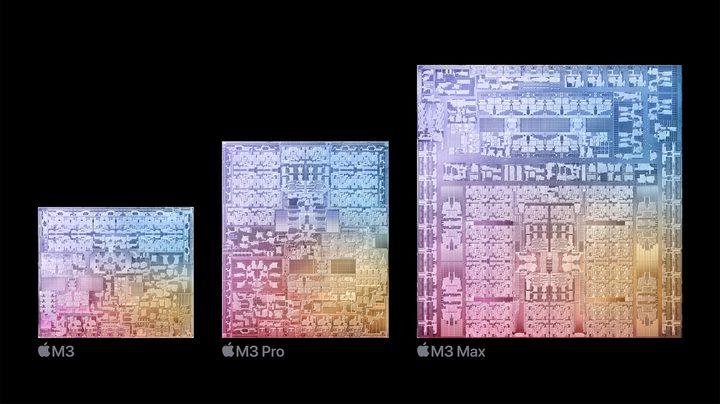
Apple changed the M3 Pro a bit compared to last-gen’s M2 Pro as well. The M3 Pro comes with six performance and six efficiency cores, while the M2 Pro has eight performance cores and four efficiency cores. It looks like an unexpected downgrade on paper, though the node advantage of the M3 Pro should mean it will still offer higher performance.
Apple says the performance cores of the M3 family are 30% faster than the M1 and 15% faster than the M2, while the efficiency cores are 50% faster than the M1 family and 30% faster than the M2 family. That means M3 chips represent a 20% to 25% improvement over the M2 based on the node advantages, but as usual, we’ll have to wait for third-party benchmarks to verify Apple’s claims.
Dynamic Caching and ray tracing

The process shift is significant for the M3 family, but Apple is also touting an entirely new GPU architecture. The key feature of this architecture is Dynamic Caching, which promises to increase average GPU utilization and improve performance by only using the exact amount of memory that tasks need.
How Dynamic Caching works is a little complicated. It appears the feature keeps complex GPU programs called shaders from taking more memory than they need, thus allowing simpler GPU programs to finish faster. This should, in theory, improve performance.
It seems Dynamic Caching has enabled a few key features of the M3 family. One of those is hardware-accelerated ray tracing, allowing Macs to finally take advantage of this feature in games. There aren’t a ton of games that support ray tracing on Mac, but hopefully, we’ll see more now that an Apple chip has official support.
The other is mesh shading. Mesh shaders have been around for a few years on Windows PCs, but they’re only now becoming an essential feature for gaming. Support for mesh shaders isn’t a feature that matters much right now, but it sets the M3 family up well for the future, especially if Apple continues its push into Mac gaming.
Which Macs have M3 chips?

We expect that Apple’s full lineup of Macs will eventually transition to M3 chips, but for now, they’re only available in two products: the 24-inch iMac and the MacBook Pro. You can’t mix and match the M3 chips with the products, though. Apple has them split up in a specific way.
Here’s how that breaks down:
- 24-inch iMac — Only M3
- 14-inch MacBook Pro — M3, M3 Pro, or M3 Max
- 16-inch MacBook Pro — M3 Pro or M3 Max
As for the next products that will receive an update, it’s tough to say. Rumor has it that Apple is still working on a 27-inch iMac Pro for early next year, so we could see that product sporting the M3 Pro and M3 Max chips some time early in 2024. The iMac Pro is going on six years old at this point, though, so it might be a dead product.
The obvious candidate for an M3 upgrade is the Mac mini. Apple last updated the Mac mini in January 2023, and it remains the most cost-effective way to get in on Apple silicon. We suspect that this will be the next product to receive an M3 upgrade, at least based on Apple’s normal release cadence.
A couple of products we don’t expect to see upgrades to for a while are the MacBook Air and Mac Studio. Apple just released the 15-inch MacBook Air and the M2 Mac Studio in June 2023, so we probably won’t hear updates about these products until late in 2024. On top of that, Apple is still selling the MacBook Air M1, suggesting that it will hold back an M3 upgrade for as long as it can.
Entry-level M3 performance
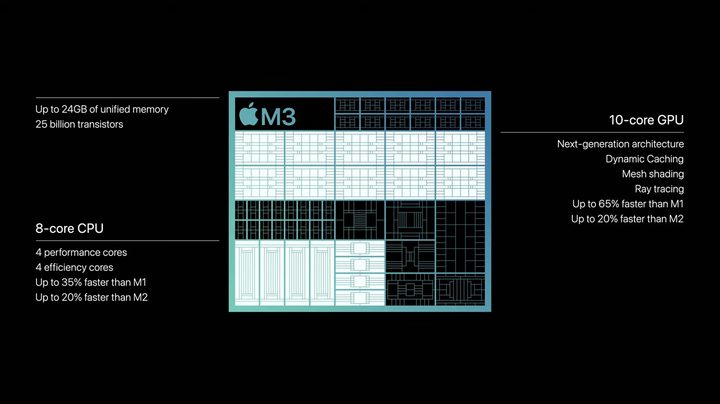
The base M3 chip is only available in two products right now, but Apple is claiming some massive performance gains. The company says the 8-core CPU is 35% faster than M1 and 20% faster than M2, while the 10-core GPU is 65% faster than the M1 and 20% faster than the M2. It’s important to note those are “up to” numbers, meaning you won’t always see that high of a performance gain.
In specific apps, Apple says the M3 inside the 14-inch MacBook Pro provides 40% faster image filter and effects performance compared to the M2 in the 13-inch MacBook Pro. That’s the only comparison to the M2 that Apple has provided so far, though. Compared to the M1 in the 13-inch MacBook Pro, Apple says the 14-inch M3 model provides 60% faster render performance in Final Cut Pro, 40% faster code compilation in Xcode, and 40% faster spreadsheet performance in Microsoft Excel.
For CPU tasks, it seems the gains made by the M3 compared to the M2 are relatively small. It’s the redesigned GPU that looks like the main performance driver, likely explaining the massive leap Apple is claiming in image filter and effects performance.
We suspect the M3 will truly shine in the 24-inch iMac, which has been restricted to the M1 since it launched. Overall, Apple says the M3 model is twice as fast as the M1 model. Apple says Safari and Microsoft Excel performance are up to 30% faster, gaming achieves 50% faster frame rates, and Final Cut Pro and Photoshop are up to twice as fast.
As is usually the case with Apple’s benchmarks, you shouldn’t take them at face value. They’re vague, and even if Apple’s claims are true, it’s important to wait for third-party benchmarks to see if the extra performance carries any caveats.
Performance for the high-end chips

Moving up the stack to the M3 Pro and M3 Max, the gains compared to previous generations start to slip. The 12-core CPU on the M3 Pro is up to 20% faster than the M1 Pro, according to Apple. Interestingly, Apple didn’t provide a comparison to the M2 Pro. That could be because there isn’t much of a gain in the CPU department. Apple says the 18-core GPU provides up to a 40% improvement over M1 Pro, but only a modest 10% improvement over M2 Pro.

The same isn’t true for M3 Max, where Apple is claiming the highest generational gains out of the M3 family. The company says the 16-core CPU is up to 50% faster than the M2 Max and up to a massive 80% faster than the M1 Max. Similarly, the 40-core GPU is up to 20% faster than the M2 Max and up to 50% faster than the M1 Max.
In practice, Apple claims that the M3 Pro achieves 40% higher performance in Photoshop and 30% faster editing in Premiere Pro compared to the M1 Pro. Unsurprisingly, the M3 Max shines more, achieving twice the performance of the M1 Max in MathWorks, 2.5 times the performance of the M1 Max in Maxon Redshift, and 65% higher performance in DaVinci Resolve.
Out of the M3 family, it certainly seems like the M3 Max is the chip that truly stands out. We expecting middling CPU gains and a solid increase in GPU performance from all chips, but it seems the M3 Max has big gains for both the CPU and GPU, at least according to Apple’s numbers. Once again, it’s important to wait for third-party testing to verify Apple’s claims.


